What is a Unified Media Platform?
A Unified Media Platform (UMP) runs search, social, and programmatic from one system. See what to look for and how to add governed agentic automation.
Published on
November 17, 2026

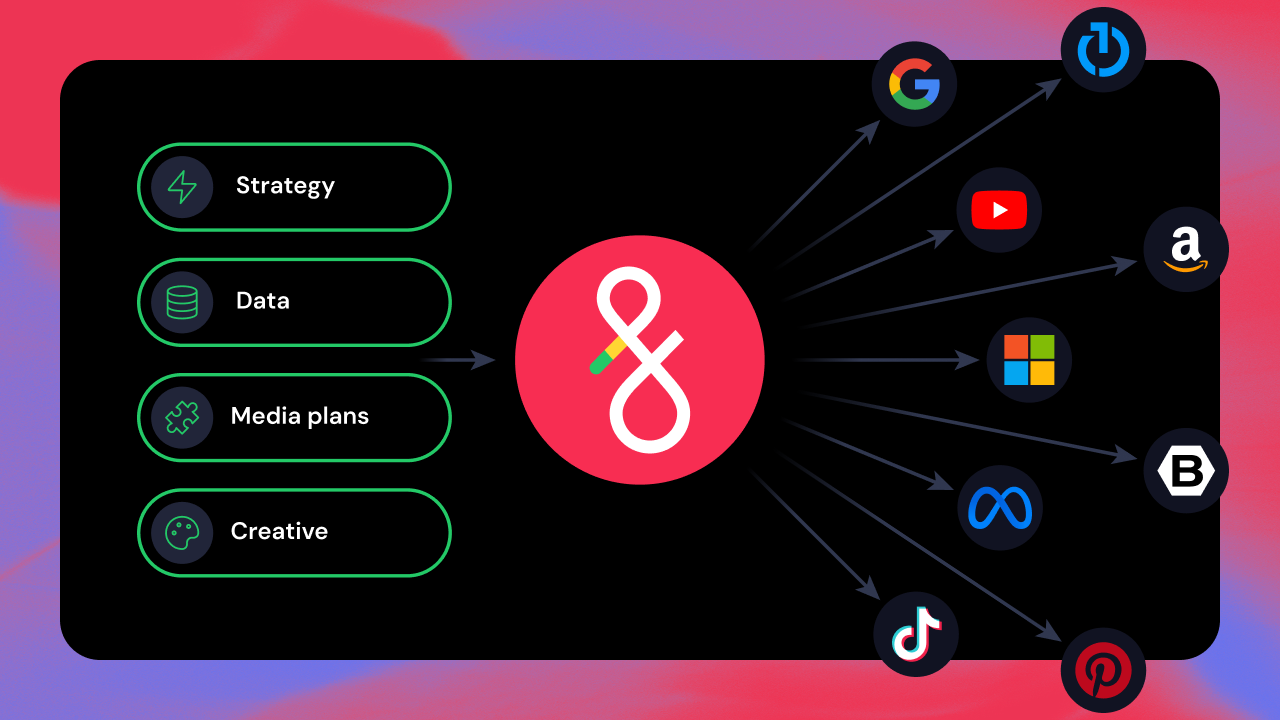
A Unified Media Platform (UMP) uses ad platform APIs to bring every advertising channel into one system for end-to-end multichannel campaign management. With a UMP, advertisers can build a campaign once and launch it across search, social, and programmatic channels simultaneously. Teams use a UMP for ongoing campaign and budget management, plus comprehensive multichannel reporting.
---
Even with the rise of AI and agentic advertising solutions, most campaign management tasks are done by hand. Your teams set up campaigns channel by channel, manually QA individual elements, and export data from separate ad channels to assemble monthly reports.
For agencies, that work grows in step with headcount, which squeezes margins: LT.agency estimates that 70% of its cost base is headcount. For brands, it caps how many accounts and locations a lean team can run without errors.
A Unified Media Platform breaks the link between growth and headcount by bringing all your ad accounts into one system for scalable multichannel campaign management. This guide covers what qualifies a system as a UMP, the problems it solves for both agency and in-house advertising teams, and where an Agentic Advertising Operating System fits in the category.
Launch, manage, and report on multichannel campaigns from within one system
With a UMP, you can launch campaigns on search, social, and programmatic channels at the same time, all from a single workflow. API connections to ad platforms funnel each channel’s performance results back into the UMP, giving you one view for multichannel results without manual exports.
For the system to automate these tasks and be qualified as a UMP, the system must:
- Be able to take in data from ad channels as well as your own sources. Combining your first-party data (CRM records, inventory feeds, creative assets) with multichannel performance data is a UMP’s primary benefit in executing end-to-end advertising operations.
- Connect to ad channels through bidirectional APIs. This is what enables the platform to read and write to live campaigns and budgets.
- Be a single, comprehensive workspace that gives your team the ability to launch, manage, and report on multichannel campaigns in one place.
All three of these qualifications must be met for the solution to be considered a Unified Media Platform. For multi-location advertisers, this means one campaign structure can carry hundreds of location-specific budgets, offers, and creative across every connected channel.
What problems a unified media platform solves for agencies and brand teams
A Unified Media Platform reduces the manual work slowing agency and brand teams down as they grow. By giving your teams the ability to manage cross-channel workflows within one system, a UMP replaces channel-by-channel logins, tracking spreadsheets, and manual report builds.
Stitching together separate tools leaves gaps. Reporting tools show results, rules engines act on a single platform, and workflow software tracks tasks. But none of them connect live business data to governed execution across every channel, which is the gap a UMP closes.
Automated multichannel reporting without manual exports
A Unified Media Platform pulls results from every connected ad channel into one place continuously and automatically. Your teams don’t need to export data and rebuild monthly reports, over and over, to piece together what happened and why. Most importantly, each report consistently draws on the same structured data, making it easier to compare channels side by side and answer client questions without reconciling numbers first.
Advanced UMPs can agentically aggregate multichannel performance metrics and deliver branded reports to every one of your clients on a set schedule. When Cox Automotive adopted Fluency’s agentic multichannel reporting workflows, they delivered monthly client reports 66% faster than their manual workflows.
Build and QA multichannel campaigns from one workflow
A Unified Media Platform gives your advertising teams a UI that enables them to build a campaign once and launch it across channels from one workflow. By not setting up each channel by hand, your team can save hours of repetitive setup work and drastically reduce errors.
Reusable campaign frameworks reduce build times and errors by automatically applying the correct naming and structure rules when a plan is approved. The system builds governed, platform-compliant campaigns across every connected channel, according to your defined strategic rules. Instead of manually assembling and checking every campaign, your team only needs to review the campaign framework structuring the buildout.
CyberMark reports 80% time savings on campaign setup and a 99% reduction in campaign errors on new launches using Fluency Blueprints.
Automate budget pacing across channels and campaigns
A UMP tracks spend against multichannel budgets from one place, saving your people from tracking pacing in spreadsheets or reviewing accounts one by one.
A UMP can pace budgets across multiple channels automatically, protect budgets against overspend, and help reallocate funds between campaigns or channels to mitigate underspend (within guardrails you set). Fluency’s pacing runs at 99%+ accuracy.
Johnson Group, an agency specializing in multi-location franchise advertising management, used automated budget pacing to reduce the time spent pacing budgets by 90%: instead of the team spending 12-15 hours a week on pacing, it takes less than five hours every month to perform the same tasks.
Catch issues before clients do with autonomous error detection
Because a Unified Media Platform connects to every channel account and holds results in one place, it can scan every account for unexpected configurations. This portfolio-wide level of real-time, multichannel insight gives your team the ability to find and fix problems before a client spots them.
Fluency’s anomaly detection feature flags irregularities (e.g., accounts without overspend protection, budgets on manual hold, or unusual pacing strategies) and delivers them to teams with a recommended action. Best of all, your teams can fix many accounts at once with bulk management capabilities, which apply the same fix across multiple accounts in a single action.
Grow accounts without adding a buyer for each one
By bringing campaign management, budgeting, and reporting into one system, a unified media platform enables strategists to manage more accounts and campaigns with less stress. As a result, you can adopt new channels or add more accounts without having to hire new strategists at the same rate as your growth.
LT.agency adopted Fluency to grow without hiring at the same rate.
“If I can serve more clients, if I can serve clients at a higher scale and I can do that with a slowdown in the rate at which I need to hire, then that is a win,” said Chase Lane, CEO of LT.agency. Now, the digital media team uses agentic automation workflows to cut the hours spent making campaign changes on Meta by 98% compared to their previous manual workflows.
How an agentic advertising operating system fits inside the unified media platform category
An Agentic Advertising Operating System (AAOS) is a Unified Media Platform that provides advertisers with capabilities extending beyond the category’s baseline. A UMP brings channels into one system so teams launch, manage, and report on campaigns from one workspace. An AAOS provides this same functionality, but it also automates the repetitive campaign work itself, under governance rules your team defines.
There are three things that an AAOS provides advertisers that not every UMP provides:
- Live business data drives governed task execution: where a UMP takes this data in, an AAOS acts on it. Inventory, bookings, and new creative assets trigger campaign changes without anyone watching a spreadsheet or making a manual change on each specific platform. If you can map out how your team makes a specific decision or the actions they take when a data source changes, you can pass these approved rules over to agents to carry out these routine tasks.
- Governance rules control every action: agents carry out campaign work inside governance rules your team writes. Every action an agent takes is auditable. Separate insight agents also analyze results and recommend changes, and your team decides which to apply.
- It can handle non-standard campaigns at scale: Industry vendors note that most current UMPs work best under fairly standardized structures. An AAOS, like Fluency, enables your teams to set up, manage, and, under pre-set rules, autonomously update complex campaign structures. This includes thousands of localized campaigns with location-specific budgets, offers, and creative.
Fluency is an AAOS, which makes it a unified media platform. For the last nine years, Fluency has used agentic workflows alongside a governance layer to help advertisers manage hundreds or thousands of digital ad campaigns through one structured campaign framework. Now, nearly $3 billion in annual ad spend is managed by the system every year, with every action running inside rules advertisers define and can audit.
How an Agentic Advertising Operating System works: live data, governance rules, and agentic workflows
Storage Rentals of America, a national self-storage brand with 650+ locations, uses Fluency’s AAOS to bring live business data and high-volume campaign management together.
When Melissa Cartagena, SROA’s Chief Digital Officer and CMO, started, two people managed paid media across 650 stores. Her team centralized occupancy, pricing, and move-in data in Fluency. They set up agentic automation workflows that would use live business conditions (such as location-specific occupancy rates) to drive campaign performance and changes.
Now, the team does far less manual setup and execution than they did before using an AAOS. During a presentation at POSSIBLE 2026, Cartagena described how much the team’s capacity has increased by using an AAOS. According to Cartagena, if SROA acquired another 100 stores, “I now know that I can launch them within a 24 to 48-hour period of time” instead of the weeks it used to take.
What should you look for in a Unified Media Platform?
As you review different UMP vendors and sit in on demos, look for five things: channel coverage, governance and auditability, data connections, reporting, and scale.
- Channel coverage: Direct connections to search, social, and programmatic channels, including DSPs.
- Governance and auditability: Encoded rules control what the system can change, plus a record of every action taken (whether executed by a human or an agent).
- Data connections: The ability to take in first-party data such as CRM records, inventory feeds, and creative assets.
- Reporting: One report across every channel, built from the same structured data and delivered on a schedule.
- Scale: The capacity to handle more accounts, campaigns, and locations without hiring at the same rate.
Fluency, an AAOS, is built around all five of these capabilities. If you want to see how these five components come together for scalable multichannel advertising campaign execution, set up time with our team.
Frequently asked questions
What is a unified media platform (UMP)?
A unified media platform (UMP) is a system that connects to ad channels through bidirectional APIs, so teams can launch, manage, and report on search, social, and programmatic campaigns from one workspace. It also takes in first-party data, such as CRM records and inventory feeds, so business inputs and multichannel results sit in the same place. Teams stop logging into each platform separately.
How is a Unified Media Platform (UMP) different from an Agentic Advertising Operating System (AAOS)?
An Agentic Advertising Operating System (AAOS) is a type of UMP. A UMP brings channels into one system; an AAOS also automates the repetitive campaign work inside rules defined by your team. An AAOS does everything a UMP does, plus three additional capabilities. An AAOS acts on live business data to drive governed task execution, controls every agent action through auditable governance rules, and handles complex campaign structures at scale.
How is a unified media platform (UMP) different from a demand-side platform (DSP)?
A demand-side platform (DSP) buys programmatic ad inventory. A unified media platform manages campaigns across search, social, and programmatic from one system, and it connects to DSPs as one of those channels. Fluency, for example, connects to The Trade Desk, Amazon Ads Agent, and DV360 alongside Google, Meta, and Microsoft.
How is a unified media platform (UMP) different from a unified advertising platform (UAP)?
A unified media platform (UMP) brings ad channels together into one system so advertisers and agencies can launch, manage, and report on search, social, and programmatic campaigns in one place. A unified advertising platform (UAP) serves both sides of an ad transaction, combining demand-side platform (DSP) and supply-side platform (SSP) capabilities into one system that handles buyer bidding and optimization alongside publisher inventory management.
Digiday credits analyst Karsten Weide with coining the term UAP; Aperiam developed the term UMP. Fluency is a UMP, and its Agentic Advertising Operating System runs campaign execution across channels, including DSPs such as The Trade Desk and Amazon Ads Agent.
How do enterprise brands manage ads across hundreds of locations?
Enterprise brands managing ads across hundreds of locations use a UMP to run each location’s specific creative and strategic parameters from one campaign structure. Location-level data and encoded rules set budgets, offers, and creative for each location. As a result, teams stop building and adjusting each location by hand. Storage Rentals of America, with 650+ locations, centralized its occupancy, pricing, and move-in data in Fluency. Now, the company’s CMO says the team could launch 100 additional stores within 24 to 48 hours.
Related Posts
Agentic Advertising Operating System: What it is, How it Works, and Key Benefits