LT.agency Decouples Growth from Headcount Using Agentic Ad Operations

LT.agency (LT) is a full-service, independent marketing agency based in Phoenix, Arizona. Over the last 60 years, the agency has built its reputation on managing complex, multi-location accounts across vastly different industries. LT’s strategies focus on localized relevance for each client with a precision most agencies can only achieve by specializing in a single industry.
However, as LT’s portfolio of multi-location clients grew, the agency’s paid media team started hitting manual workflow limits. The agency needed a way to scale campaign output without sacrificing valuable localization tactics. LT turned to Fluency to re-align their digital advertising operations from a manual labor-intensive process into an enterprise-grade operation: all powered by AI, agentic automation, and their team’s strategic direction.
The challenge: "Whac-A-Mole" manual ad campaign management
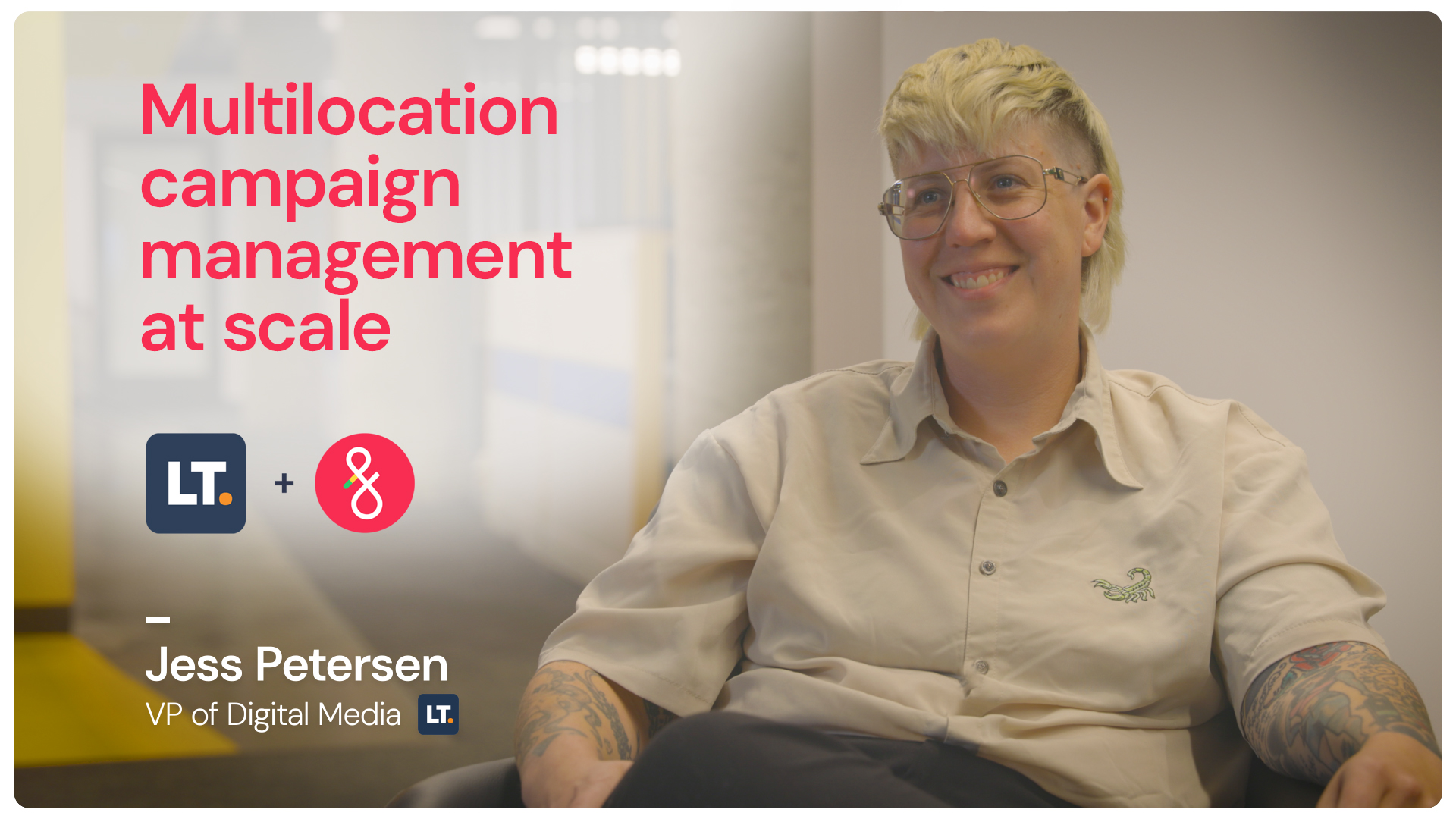
Shortly after landing a huge new franchise client, Jess Petersen (VP of Digital Media at LT) was manually cloning 1,600 campaigns across four different channels for a massive franchise launch—on Christmas Eve.
“I was copy-pasting so fast that Meta’s platform thought I was a robot and would lock me out for a few hours at a time,” Petersen recalled. “I kept thinking, ‘There has to be a better way.’”
For every new location build or creative refresh, the team faced what Petersen refers to as a "Whac-A-Mole" scenario. Petersen estimates that a standard Meta creative refresh (such as a single URL update or image swap) for a large client routinely took 40 hours of manual labor. The team had to triple-check dozens (or hundreds) of ads to make sure the change was correctly implemented across the right multilocation campaigns.
“We never want to say ‘no’ to a client’s idea because the manual workload is too high, but we were reaching a point where scaling meant an impossible amount of work,” Petersen added. “I didn’t want to do that to anyone on my team.”
The decision: searching for an “agency engine” for LT’s advertising operations
As the LT team began their vendor search, they found a lot of solutions that could handle specific aspects of their advertising operations. For instance, Petersen said there are “a lot of tools that will help with pacing or notifications.” But what LT needed was something that addressed the bigger picture (and challenges) across all of their advertising operations.
“I don't think I knew exactly what that end product would look like,” Petersen admitted. “I just knew it had to be bigger than just a pacing or cloning tool.”
Chase Lane, CEO at LT, also wanted to make sure that whatever tool the paid media team brought in aligned with the agency’s long-term vision. Specifically, Lane wanted a solution that enabled both team capacity and scalable infrastructure.
“When evaluating any investment, I’m looking for the ongoing value,” Lane explained. “In an agency where 70% of the cost base is headcount, I’m always asking: does this software make my existing team more efficient? Does it allow us to deliver higher quality work without having to constantly hire more staff just to keep our heads above water?”
Lane and Petersen both recognized Fluency as the answer for how their agency could re-engineer the “engine” of their paid media operations from the ground up. Fluency’s Digital Advertising Operating System (DAOS) meant the LT team could use agentic automation to handle execution. This freed up strategist teams to build higher-performing strategies while also enabling the sales team to onboard and grow accounts faster.
The team was drawn to Fluency Blueprints because they could codify/standardize LT’s unique advertising strategies across different industries. Blueprints serves as a high-level operational framework, ensuring ads change automatically based on real-world conditions or pre-set rules set by LT’s advertising experts.
With a tool like Blueprints, Petersen believed the team could build strategies that don't just launch locally: they live locally, optimizing in real-time as contextual parameters change.
Using Blueprints meant LT could apply the same high-level logic to a retail client’s upcoming local sale as they do to a homebuilder’s “Now Selling” ads for a new community. By codifying the overarching logic they know drives client results, LT could manage campaigns for any industry en masse simply by connecting Blueprints to live data feeds that trigger automatic adjustments based on real-world conditions.
“After I saw the Fluency demo, I could envision how we could take a small team and support a large volume of campaigns with accuracy and speed,” said Petersen.
The shift: navigating the change from manual tasks to agentic AdOps
Like any software integration, implementing automation wasn't an overnight switch. Petersen and the paid media team worked with Fluency to evolve LT’s approach to multichannel management. LT leaned into making these operational changes internally (including some of the gnarlier components of change management) by asking strategists to rethink their roles outside of being manual platform operators.
“Digital advertising is, at its core, a data structure,” Petersen explained. “Whether you’re advertising for a healthcare provider or a homebuilder, the foundational logic is remarkably similar. Once you build a system that works, you can replicate that excellence across any industry. That’s what Fluency is actually doing. It turns a month of manual labor into an engine that replicates our best work across every single client.”
Colin Mekenney, Associate Director of Digital Media at LT, spearheaded much of this operational shift. Fluency’s Blueprints enabled Mekenney and his team to codify their localization strategies for different industry verticals, including LT’s retail and homebuilding clients. This allowed them to pull off complex multi-location builds, launches, and ongoing management with fewer resources while maintaining valuable localized strategies.
“What was a nearly insurmountable monthly task before, like changing creative or copy, became a proactive strategy that we could really act on in a structured manner,” Mekenney said. “We can go into a pitch to a new client knowing that we won’t mess up the tiniest details because the system is built to handle the nuance at scale.”
“It feels like magic,” he added. “It's a game changer for an independent agency like us.”
Winning new clients without the “hiring trap”
For LT, one of the biggest gains was the ability to pitch new clients without the fear of immediately hiring new staff once they won the business. Historically, landing a massive multi-location account meant a frantic race to find, hire, and train new analysts just to keep up with any timeline promises made during the pitch.
“Before, there was a real fear about what would happen if we actually won a major franchise account because of the manual workload involved,” said Petersen. “I was much more apt to disqualify something because I didn't want to be the person to say ‘we actually can't do this,’ but I also didn't want to subject the team to that level of work without a better tool. We needed a solution where growth didn't always mean adding headcount.”
By decoupling their growth from a linear increase in headcount, LT can now confidently pitch and launch complex strategies for large brands or franchises on a timeline that would be impossible for an agency that relies on manual workflows.
Petersen believes this newfound operational agility gives LT a massive competitive edge. Now, the agency can run localized media strategies while keeping its media operations lean. Most importantly, the team is ready for the next big win instead of stressing about it.
The results: a new agentic operating model drives 98% time savings and improved capacity
For LT, the true measure of success is found in the agency's newfound ability to say “yes” to complex client demands without hesitation. However, the data confirms that this strategic shift is underpinned by massive performance gains.
For example, Petersen and Mekenney both said that creative refreshes for some of their multi-location clients could previously consume an entire work week (40 hours). Automating campaign updates via Blueprints reduced these swaps to just 15 to 20 minutes—a 98% decrease in time spent on making campaign changes.
These operational efficiency gains translated directly to client performance, too. For one key franchise client, LT saw a staggering 456% increase in form submissions year-over-year. Using automation to optimize bidding and placement also resulted in a 71% reduction in Cost Per Lead (CPL) and a 14% decrease in Cost Per Click (CPC).
“With Fluency, I can promise clients speed, accuracy, and transparency,” said Petersen. “Before, I had to sacrifice something.”
Beyond the numbers, the partnership between Fluency and LT has also helped improve client satisfaction.
“Our clients are receiving more value because we’re spending less time clicking buttons in a platform and more time thinking about their business,” said John Sizer, VP of Account Services at LT. “We can now say ‘yes’ to localized requests that were previously impossible from a time-management perspective.”
Like many of LT’s other technology partners, Lane sees Fluency as a critical component for the agency’s future by giving him “the decisional space to grow the agency strategically.”
“Tools like Fluency give me the ability to exert my business judgment outside of constraining operational realities,” he explained. “For example, we hired three more people to the creative team last quarter. Previously, the media team would have very likely demanded those resources just to keep up with demand.”
Lane also credits Fluency’s agentic automation with helping Petersen and the paid media team “consume fewer resources while delivering the same—or higher—quality of work.”
“We want to move fast and operate at a high speed, but we also need to be purposeful in doing so,” he said. “Fluency approaches their product in the same way, and it delivers real results. On top of that, we’ve just been very happy with the way in which Fluency approaches us as their partner.”
Related Content