
Agentic automation in advertising uses software agents to take action on live ad campaigns without a human executing tasks: an AI agent proposes what to do, and a deterministic agent decides whether that proposal is allowed to happen based on encoded governance set by human teams. For media buyers and AdOps teams, a deterministic governance layer is what makes agentic automation safe to run at scale.
---
Every vendor pitching AI in advertising right now calls itself "agentic." The truth is that bolting an AI chatbot into a rules-based automation platform isn't true agentic automation. Neither is an LLM that writes you a few headline variations and waits for someone to click "approve."
The distinction between what’s truly agentic automation and what’s AI-assisted (but ultimately manual) workflow matters because it changes who's accountable when something goes wrong. If an AI agent's proposal goes live without anything (or anyone) double-checking the action against your compliance rules, the responsibility of any budget overspend or noncompliant changes falls to your team.
Agentic automation is designed to be fully auditable, built to answer for itself: what happened, why the action went live, and under which rule. That level of accountability is what makes agentic automation truly safe to scale, not just a suped-up chatbot.
This article explains more about how agentic automation works within digital advertising, what goes wrong when governance is missing, and how it compares to programmatic and AI-assisted advertising.
How does agentic automation in advertising actually work, step by step?
Agentic automation runs on two steps, not one. First, a reasoning (AI) agent receives a signal from one of your data sources. This might be a primary source (such as a specific store’s inventory status or a property’s occupancy rates) or it could come from a third-party source (such as channel performance data, local weather conditions, or a competitor’s actions).
Based on the signal, the agent will propose a specific action to keep everything moving toward your set goal. These actions could be anything: increase a specific budget, launch this win-back campaign, or pause this “limited time offer” ad. Anything the AI proposes is probabilistic, generated from natural-language intent. That means the AI’s recommendations about what to do can vary between runs.
Before the AI’s recommended change can go live, though, it passes through a governance layer. This deterministic layer evaluates the proposal against human-authored rules and verifies that the action has been pre-approved by your team’s playbooks, compliance requirements, or client brand guidelines.
This governance layer can catch other changes, too, not just AI-generated proposals. Anything that changes a live campaign, whether it starts with an ad strategist chatting with an AI agent or comes through as a status change in a document, runs through the same deterministic layer before it touches a platform.
What happens when AI recommendations go live without a governance layer checking for compliance
Without proper governance encoded into your agentic automation workflows, LLMs can implement changes on live campaigns that are expensive, impossible to revert, or—worst-case scenario—both.
Let’s say, in an effort to save time and maximize performance, your team wires an LLM directly into Google Ads' API with one instruction: lift conversions on any underperforming client account.
The AI finds an account that’s converting below its expected volume for the month. However, this underperforming account runs on a cross-account bid strategy, pooled at the My Client Center (MCC) level, across 40 other client accounts under one shared Target CPA.
Google Ads Target CPA change, made by AI, without governance
In this instance, the AI identifies raising the shared target as a viable possibility to lift conversion volume on the underperforming account. Without a governance layer checking the LLM’s changes, the AI raises the Target CPA so the single account can bid more aggressively.
Unfortunately, because of how Google Ads’ bidding structure works, this single change made by the AI applies to every campaign pooled into that same strategy. All the pooled campaigns start bidding against the new AI-set target overnight.
Once Smart Bidding has mixed fresh conversion data into the shared pool, you’re stuck. Reverting the number alone won't restore the pooled campaigns’ bidding to the old baseline. The algorithm needs to gather new data at the new target setting before it stabilizes again. In other words, the other 39 accounts pooled end up absorbing the cost of a fix only intended for one account.
Google Ads Target CPA change, made by AI, with a governance layer
Now, let’s take the same scenario, but have the AI’s recommendation pass through a deterministic governance layer before going live on Google Ads. The agent proposes the same target change for the underperforming account. The governance agent validates the proposal against your company’s set rules, translates it into scope, and identifies the targeted account as sharing resources pooled across 40 accounts.
The governance agent recalibrates the AI’s recommended change to run at the account's own campaign-level settings instead of at the MCC level. This keeps the change isolated and contained to the single campaign instead of impacting the other 39 campaigns.
If no compliant version of this kind of fix exists within the agent’s governance documentation, it will escalate the AI-proposed change to a person instead of executing on Google Ads. It also records the decision so it’s fully auditable if someone wants to understand why the agent made the decision it did.
Both these scenarios use the same AI, the same overall goal, the same recommendation, and take place on the same channel. The only difference is whether anything stood between the proposal and every account riding on that shared strategy.
Can I just write governance into my AI prompts?
No, passing governance instructions to LLMs via natural language (e.g., in a well-written prompt) is not sufficient for reliable agentic advertising governance. This is because LLMs interpret prompt instructions as requests, not constraints.
Prompt-based rules aren't hard-coded, so nothing guarantees the model follows them every time. Even a specific, well-written prompt gets treated as a suggestion the model weighs against everything else it's doing, rather than a rule it can't break. This isn't unique to governance-specific prompts: this is how LLMs treat all prompt instructions.
Simply put, unless governance is encoded into your infrastructure, AI will only read your rules as suggestions.
Agentic automation vs. AI-assisted advertising vs. programmatic algorithms: what's the difference?
Agentic automation and AI-assisted advertising are often conflated. Programmatic advertising introduces a technical nuance that adds to the confusion. All three of these are very different in terms of how they decide what action to take and the technology underneath each approach.
Programmatic advertising
In programmatic advertising, bidding algorithms run on pre-written human rules, executing exactly what a human configured it to do. These programmatic algorithms don't reinterpret intent on the fly. They optimize within a fixed, pre-configured objective rather than reasoning about a given goal.
AI-assisted advertising
AI-assisted advertising puts AI in an advisory seat but relies on humans for execution. A human being reviews AI-generated recommendations (such as a bidding update or creative copy variations) and decides which ones to execute. With AI-assisted advertising, a human still executes AI suggestions manually where they need to be made; AI never touches a live account directly in this workflow.
Agentic automation in advertising
Agentic automation uses AI agents to propose actions toward a goal (not a pre-set rule) and governance agents to decide whether the AI agent’s proposal is viable to implement on live campaigns. If the human-coded governance rules say the change is good, the agent pushes the change out to the correct channel. If the recommendation isn’t clearly supported or approved by humans, the agent will refuse to push it live or flag a human for manual review first.
For each of these approaches, risk is managed in a different way. In programmatic, teams contain risk by writing rigid rules for the algorithms. In AI-assisted advertising, risk sits with the human executing an unverified suggestion. In agentic automation, risk is caught at the governance layer, before anything reaches a live platform.
What it takes to run agentic automation safely, at scale, in digital advertising
A deterministic governance layer isn't a nice-to-have feature bolted onto your agentic automation operations. At a certain level of spend and accountability, governance is the difference between an agentic advertising system you can run at scale and one that can't be defended if something goes wrong.
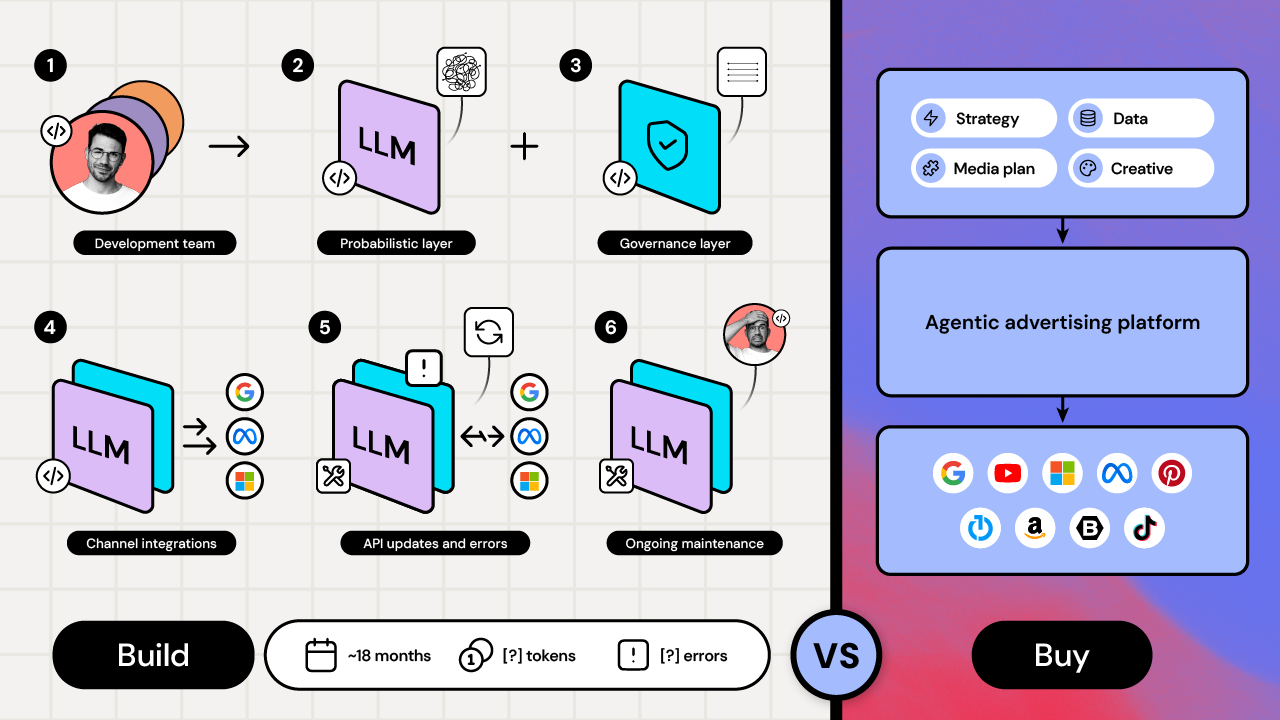
This article covered the core components of agentic automation: a reasoning agent that proposes, a deterministic agent that decides and executes based on human-set governance. But building and a fully-operational agentic advertising operation, at production scale and with real spend on the line, is a much bigger undertaking.
The Agentic Advertising Playbook walks you through everything you need to know to bring agentic operations into your AdOps. This detailed playbook goes deeper into the necessary architecture, the build-vs-adopt decision, highlights eight repeatable use cases, and features production case studies from advertisers running agentic automation at scale today.
Frequently asked questions
What is agentic automation in advertising?
Agentic automation uses software agents to implement actions on live ad campaigns without a human at the point of execution. A reasoning agent, which is AI-powered, proposes what to do (e.g., make a budget change, revise audience parameters, or pause an outdated ad). A governance layer, built on deterministic rules, takes every AI proposal and decides whether it is allowed to go live. If it is, the governance agent translates it into the right platform call and executes it on the necessary platform. If not, the agent blocks it from hitting live campaigns and flags a human for help.
Both parts—an AI reasoning component and a deterministic governance component—have to be present for it to count as agentic automation.
Is agentic automation the same as programmatic advertising?
No. Programmatic algorithms can't adapt to new intent without a person rewriting the rules first. Agentic automation can adapt its actions based on new intent, as long as those actions fall within the governance bounds set by human teams.
Programmatic advertising runs on rules written in advance: a bidding algorithm executes exactly what it was configured to do without reinterpreting goals on the fly. Agentic automation uses an AI agent that proposes actions from a set goal, not fixed rules, and a deterministic governance layer that ensures whether AI proposals can go live.
What's the difference between a reasoning agent and a deterministic agent?
A reasoning agent is LLM-powered and probabilistic: it interprets intent and proposes actions, which means even identical input prompts can produce different outputs. A deterministic agent is built on hard-coded rules: identical inputs produce identical outputs every time, which is why any action it takes is 100% auditable.
In practice, most agentic advertising workflows use both types of agents (a reasoning agent to propose, a deterministic agent to check and execute) rather than relying on only one type.
Does agentic automation remove humans from advertising decisions?
No. In fact, agentic automation relies on human to set the right decisions in the first place. Humans write the rules that govern what agents are allowed to do. This includes strict constraints like setting budget caps or brand guidelines. Humans must also stay in-the-loop for agentic workflows by retaining the ability to override any agent action.
What changes within an agentic advertising program is how humans spend their workday. Instead of manually executing repeatable tasks, people focus on setting strategies, designing agent guardrails, working one-on-one with clients, and reviewing any decisions that require true judgment rather than merely execution.
How is agentic automation different from a chatbot or AI assistant?
A chatbot or AI assistant is a conversational interface that provides you with answers, but agentic automation can safely execute on those answers autonomously. While an AI assistant can recommend next steps or generate ad copy variation, agentic automation goes further: it can take an AI-written proposal, evaluate it against compliance rules, and execute it directly against a live ad platform if it clears the governance layer—all without a person clicking a button.
How can I tell if an agentic advertising platform enforces true governance?
Ask where governance lives within the platform: it should be enforced in infrastructure before a platform call is made. If a vendor states that you must deliver rules or compliance inside individual AI prompts, it is not a truly governed agentic system.
You can also ask for a full audit trail of what an agent did, when, and under which rule. Or, you can ask what happens when an AI proposal has no compliant path. A real agentic advertising system escalates to a person instead of setting it live anyway.
Vague answers to any of these questions indicate that governance isn’t enforced within the system’s architecture.
Related Posts
What High-Volume Agencies Need in a Google Ads Automation Platform