The Deterministic Execution Layer: How to Safely Connect AI Agents to Ad Platforms
Published on
July 20, 2026


This guide is for paid media and AdOps leaders who want to move faster with agentic tools without handing the keys to probabilistic AI models. The short version: put a deterministic execution layer between your AI and your live budgets to keep ad platforms from taking very real, irreversible actions.
Most advertising teams considering agentic tools are asking the wrong question. They're asking, "Which tasks can we hand to an AI agent?" when the real question is, "What sits between our agents and our live ad spend?"
Here’s why: wiring an LLM directly to Meta's or Google's advertising API isn’t the same as building a true agentic advertising operation. Asking AI models to handle campaign budget management—a workflow with zero tolerance for variability—is a recipe for disaster because these probabilistic models weren’t designed to operate inside platform-specific systems.
To use AI and agentic tools safely in your advertising operations, you need a deterministic execution layer that enforces hard-coded platform mechanics and business rules at the infrastructure level—before any changes go live. You need solutions that split agentic workflows into two fundamentally different jobs: cognitive reasoning (where AI belongs) and deterministic execution (where it doesn't).
This article explains why that separation isn't optional, what it looks like when it's missing, and how to build a two-layer framework for scalable agentic advertising without introducing risk.
Why adding guardrails to the prompt won't protect your advertising business or strategy
The most common response to AI execution risk is to write better prompts: tighter instructions, stated spending caps, maybe an “ask a human to review” step added at the end.
But prompt engineering isn’t the problem. The real problem is a fundamental mismatch between how LLMs produce outputs and what live advertising execution actually requires.
Large language models are probabilistic by design: they excel at interpreting intent, but they don’t produce identical, repeatable outcomes. If you submit the exact same prompt ten times, you’ll likely receive ten slightly different iterations in response. This is why LLMs are powerful assistants when it comes to complex analyses or creative ideation.
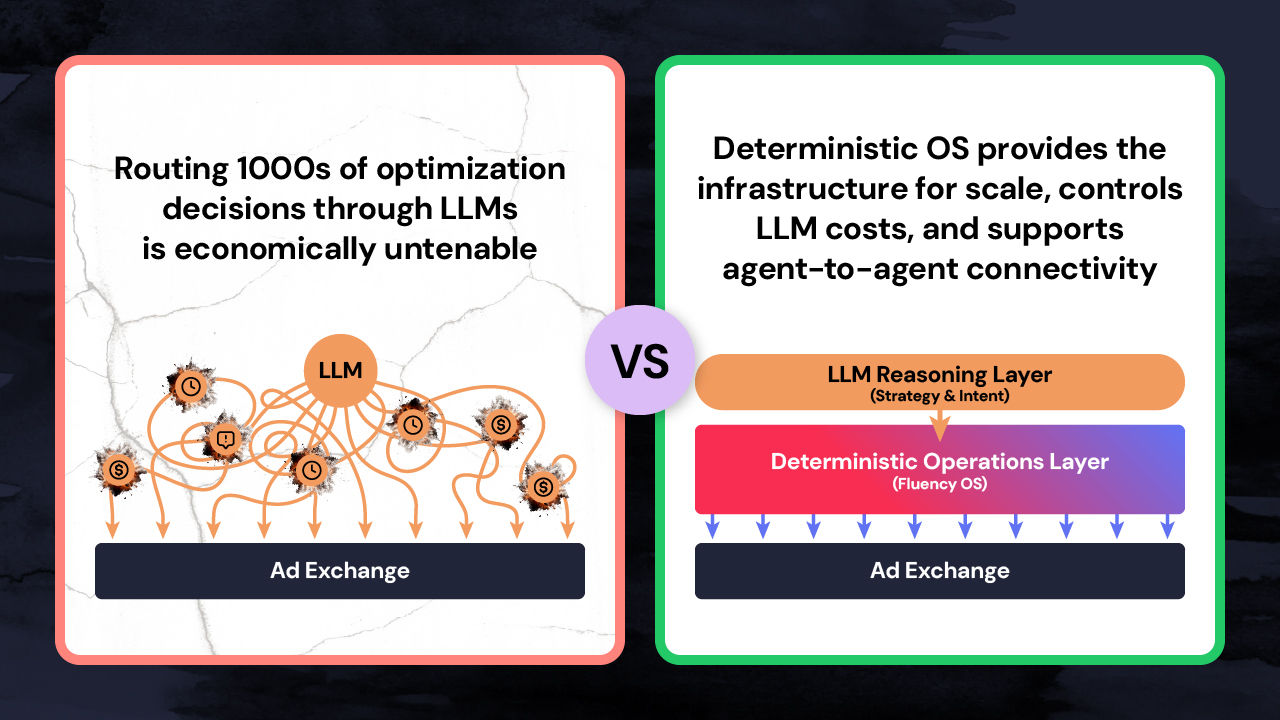
But it’s also why using LLMs to execute stringent tasks directly is incredibly risky, especially within agentic workflows. A well-written AI prompt isn’t good enough, especially when you start using agents to handle high-impact tasks like budgeting reallocations or strategic campaign changes.
Simply put, even a well-written prompt can’t act as an execution boundary.
What "direct LLM-to-API" actually looks like when it goes wrong
Here’s how direct LLM-to-API execution plays out in practice.
Let’s say you’ve wired an LLM directly to Meta’s API to help you optimize campaign performance on Facebook. The task is straightforward: “optimize underperforming ads.” The AI agent identifies what it believes to be the right tasks and the shortest path to completion.
From here, the agent starts making changes to live Meta campaigns. Some of these changes could include reallocating budgets, swapping out creative assets, or aggressively adjusting bids based on what the model determines to be the absolute shortest path to task completion.
But then, the AI agent decides to double the daily budget on a high-ROAS ad. This seems reasonable. However, when a budget increase of that size is made on Meta, it resets the ad set to the learning phase. The agent just wiped out your optimization history and tanked your performance in the process.
Here’s the thing to remember: any action taken by an agent within a publisher platform carries immediate financial consequences—even if it doesn’t align with your company’s specific playbooks or paid media best practices. Reverting changes made by AI agents can be difficult (if not impossible), and it almost always comes at a financial cost.
Now, imagine scaling this agent across your entire account portfolio, not just one campaign for one client. That’s how API wrappers can absolutely wreck your campaigns before you even know what’s happening.
How can you fix it? By bringing in a set of hard-coded rules that sit between an agent’s reasoning and your live campaigns.
What is a deterministic execution engine?
A deterministic execution engine is a set of hard-coded rules, enforced at the infrastructure level, that evaluates every AI-generated suggestion against your platform requirements and your business logic, all before a single change goes live. It forces agents to take the exact same actions every time, which means they execute predictably, consistently, and accurately at scale.
Deterministic execution is the technical difference between an operations engine that runs predictably 100% of the time and one that works most of the time…that is, until it commits a catastrophic billing error.
In order for deterministic execution to function correctly, you need to encode two things: the operational specifics of each ad platform (e.g., the mechanics that distinguish a safe budget change from one that resets to the learning phase) and your own playbooks (e.g., the compliance requirements, performance bounds, and strategic guardrails specific to your business or client).
It’s how you can get agents to communicate safely and predictably between your systems of record without anyone babysitting every single adjustment. Because this infrastructure sits underneath your entire advertising operations, it’s a great way for enterprise-scale advertisers to align their AI strategy across multiple AdOps teams.
This approach is far more sustainable (and safe) than relying on ad hoc API wrappers that fail to enforce brand-wide governance rules.
What agentic optimization actually looks like with deterministic execution in place
Let’s use the same Meta example as above, But this time, you’ve placed a deterministic execution layer between the LLM and Meta’s platform.
You give the AI the same task—"optimize underperforming ads"—and the model proposes doubling the daily budget for a high-ROAS ad. This time, though, the AI’s request hits your deterministic layer before it reaches Meta.
The deterministic execution component, governed by your specific business rules, evaluates the AI’s suggestion against your hard-coded constraints. It recognizes that increasing the budget according to the AI’s proposal would trigger a learning phase reset and violate your performance-preservation protocols.
The deterministic engine intercepts the action before it goes live. From here, one of two things happens:
- It recalibrates the budget increase to stay within your predefined thresholds; or,
- If no compliant path exists, it flags the suggestion for human review and gives your team control to take the correct action.
This is the core principle in action: the AI located the opportunity, but the deterministic engine decided how (and if) to act on it. Your advertising operation benefits from using autonomous tools to make real-time optimizations, but without the risk of incorrect budgeting decisions or performance-draining learning phase resets.
How to build a two-layer operations architecture for agentic advertising
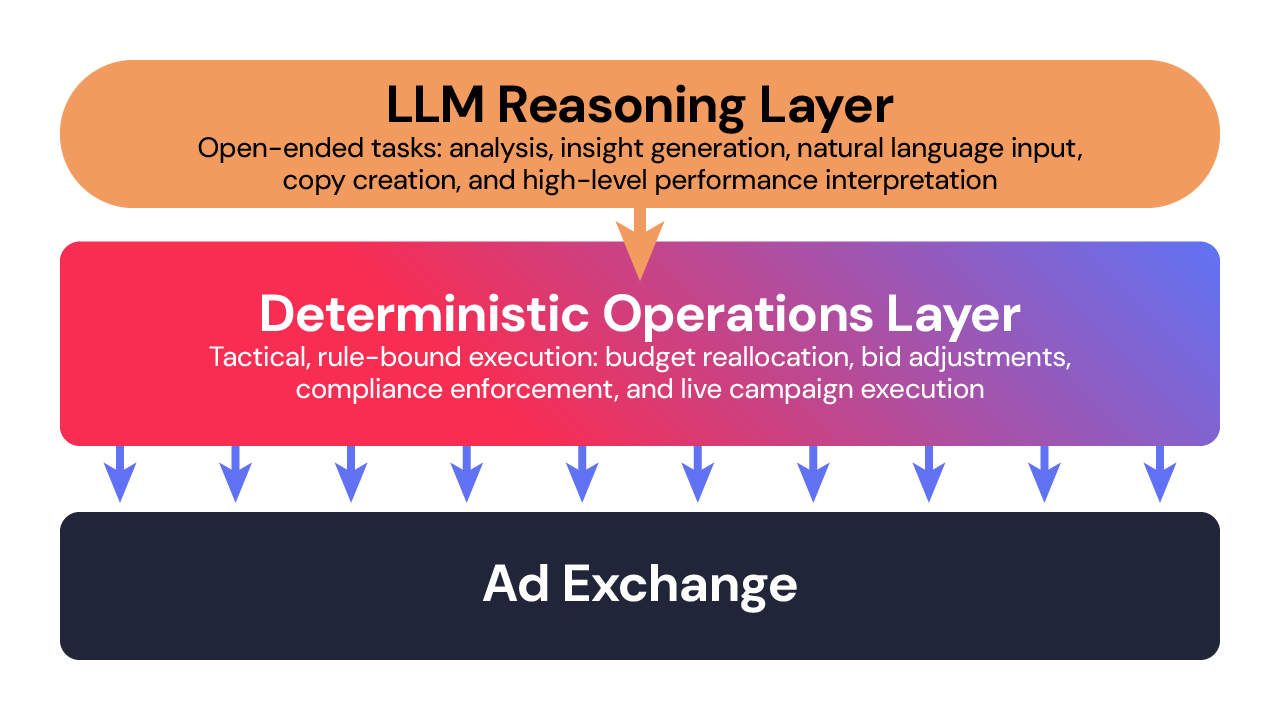
Running an agentic advertising program means cleanly separating cognitive reasoning tasks (e.g., AI) from deterministic execution (e.g., automation). Here’s what a two-layer agentic infrastructure looks like in practice for digital advertisers:
The probabilistic interface: where AI ideation belongs
This cognitive reasoning layer sits at the frontend of your agentic architecture, and it’s where AI should stay within your advertising operations.
Putting AI in charge of open-ended tasks gives it a chance to truly shine. These tasks include analysis, insight generation, natural language input, copy creation, and high-level performance interpretation. Just don’t let it actually execute these tasks on live campaigns.
The deterministic execution engine: encoding the operational DNA of your platforms and your playbooks
This hard-coded infrastructure layer sits below the LLM. Built on inspectable code, fixed business heuristics, and hard-coded platform rules, it executes a high volume of tactical tasks (often recommended by the AI layer) to power autonomous workflows. By pairing the same input with the same context, it produces the exact same action—and output— every single time it runs.
Most importantly, it does the one thing no AI can reliably do: encode each platform's nuanced operational demands and quirks. For example, a deterministic engine can distinguish between a Google Ads bid change that preserves performance history and one that invalidates it. It also understands the specific Meta budget change parameters that reset an ad back to learning phase.
Simply put, it keeps your agentic advertising workflows aligned with wider industry best practices and your company’s specific operational or strategic guardrails, compliance requirements, and performance bounds.
Without a deterministic execution component to your agentic strategy, autonomous tools can be a major liability. But with it, you’ll find that agentic workflows can be a major competitive advantage—especially if you build your strategy with this approach from the get-go.
Why rule-based automation software is critical for safe agentic execution
Automation is uniquely suited to enforce deterministic AI execution because it does exactly what it's told, every time, at infinite scale. You can be confident in its consistency.
To work correctly, though, you’ll need an automation solution that can encode rules at the depth and specificity that your advertising platforms and goals actually require.
For example, the right advertising-specific automation tool will let you set strict rules around specific actions, just like your human teams do. This might include when a budget change resets a learning phase, using different pacing behaviors for different campaign goals, or applying the right compliance requirements to specific verticals.
Encoding context-specific rules in the execution layer of your agentic workflows gives agents the necessary guardrails to move fast without breaking from your strategies, compliance rules, or budget controls.
This is something we’ve spent more than eight years building at Fluency. Today, Fluency's agentic automation solutions manage more than $3 billion in advertising spend every year for advertisers across a wide range of industries
Building a resilient, risk-free infrastructure for the agentic advertising future
Right now, advertisers have a huge opportunity to use AI for efficiency and scale. Unfortunately, most companies aren’t laying the right groundwork to mitigate the risks associated with this tech.
Implementing a two-layer operational framework that separates intent from live execution is the only way to keep autonomous AI from jumping the track. It’s especially important as agents become more deeply embedded within your advertising workflows.
If you’re interested in scaling your agentic operations, you need a way to assign the right jobs to the right tools. Let AI handle creative reasoning, but leave live campaign execution to a hard-coded deterministic engine like automation.
Your human teams, too, are given responsibilities and tasks that better align with their strengths. In an agentic advertising operation, your people have more time to foster client relationships and set high-level strategies, then lean on reliable agents to execute thousands of tasks on their behalf every week.
With the right agentic framework in place, you’ll be able to integrate agentic advertising workflows that help your teams move faster than ever without giving up strategic control.
Frequently asked questions
What is a deterministic execution layer in agentic advertising? It's a set of hard-coded rules, enforced at the infrastructure level, that evaluates every AI-proposed action against specific platform requirements and your business logic before executing the action across live campaigns. It produces the exact same result, every time, when given the same input and context. It’s a must-have to make agentic execution safe, repeatable, and auditable.
What are the risks of connecting an AI agent directly to an ad platform API? Direct connections open up the risk of a probabilistic model making irreversible, high-cost changes to live campaigns. Any of these actions, including misallocating budgets or triggering platform integrity systems that restrict your account, are very real and often hard to correct. Why? Because ad APIs weren't built for autonomous agents. This means any malformed or high-frequency requests carry real consequences, executed at machine speed.
Can a good prompt or a spending cap make direct AI execution safe? No. AI prompts shape intent, and that’s it. Even a well-written prompt can't guarantee a repeatable, compliant action. If you want agentic execution to be safe, it requires dozens of platform-specific rules enforced at the infrastructure level, not at the instruction level.
How is agentic advertising different from traditional advertising automation? Traditional automation executes fixed tasks as instructed, but it can't reason or adapt. Agentic advertising pairs a deterministic execution engine (one that’s rules-based and inspectable) with a probabilistic reasoning layer (that can interpret and adapt). It gives your AdOps the best of both worlds: strategic intelligence with governed execution. You don’t have to choose one over the other.
Related Posts

Agentic Programmatic Advertising for Multi-DSP Execution and Governance