How is Agentic AI Used in Advertising? Real Use Cases from Ad Agencies
Published on
January 26, 2026
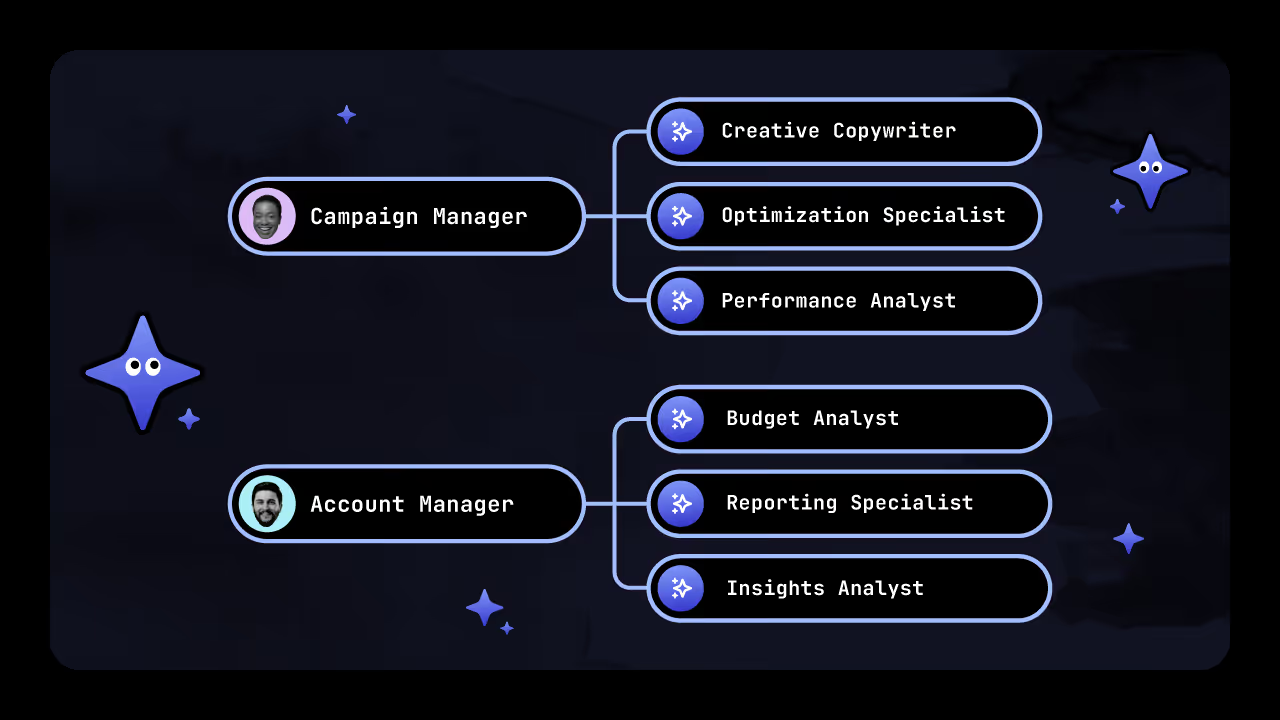

Agentic AI moves beyond analysis and into autonomous execution - handling the AdOps tasks that consume the most time without generating strategic value. For agencies managing thousands of accounts, pairing agentic AI with a deterministic automation layer means systems like Fluency's Muse can build client performance reports, troubleshoot portfolio-wide issues, and reallocate budgets without requiring a human to initiate each step. This article covers real use cases from Cox Automotive and sMedia showing exactly how that works in practice.
---
Ad operations is a critical function for any advertiser, but it is extremely task-heavy. Many teams spend their week exporting data from ad platforms, manually organizing spreadsheets, moving monthly budgets around, and reformatting reports for clients. Every hour they spend on these time-consuming (but low-value) tasks is an hour they can’t spend actually improving campaigns.
When paired with automation, agentic AI can handle much of this back-office busywork for you. Instead of just answering one-off questions or analyzing data, agentic AI can be a knowledgeable AdOps employee. Agentic AI can understand your specific processes, manage multichannel campaigns with the necessary context, and perform tasks on behalf of human teams.
This article highlights real advertising agentic AI use cases that agencies are using within their advertising operations. It also looks ahead at how agentic AI will help advertisers in the near future.
What advertising operations tasks are best suited for agentic AI today?
Think of agentic AI as an “action taker” on your AdOps team. Regular AI capabilities can identify, flag, or analyze what’s taking place within your multichannel advertising portfolio. With the addition of an agentic AI layer, technology can take specific best-practice actions on your behalf.
Agentic AI can autonomously resolve or complete necessary steps based on your predefined logic. With agentic AI independently executing the necessary problem-solving steps without manual intervention, teams have more time to spend with clients and focus on strategic initiatives.
Here are some examples of where agentic AI provides the most benefits for advertisers:
- Budgeting oversight: Integrated agentic AI can monitor every account for budget pacing issues—like campaigns spending too fast or lagging behind targets—and take the necessary actions to prevent overspend and maximize client budgets. These actions might include pausing, throttling, or reallocating budgets instantly, without human interference.
- Reporting: Instead of teams exporting and compiling multichannel reports from different platforms, agentic AI advertising reporting tools can build on-brand, client-ready reports both on-demand and on a set cadence.
- Troubleshooting and performance monitoring: In addition to monitoring thousands of campaigns simultaneously, agentic AI can execute human-approved resolutions as soon as they pop up, cutting resolution time to practically zero. This saves your team from investigating or solving problems account by account.
- Creative messaging: Agentic AI can generate new ad copy or creative assets that align with each client’s specific brand guidelines, ensuring consistency and compliance. It can also test multiple variations, identify top performers, and scale winning creatives while retiring underperformers. This allows your team to focus on strategy while the AI handles the heavy lifting of creative optimization.
What does this shift from manual to agentic execution look like in practice? Let’s look at some advertisers who use agentic AI to complete these (and other) AdOps tasks in their daily work.
Agentic AI use case for reporting: building client performance reports at scale
Cox Automotive services over 10,000 car dealerships in the U.S. across its 3,000 active advertisers. Anne Thiel, Senior Director of Advertising and Revenue Operations at Cox Automotive, helped the company implement automation via Fluency a few years ago. Their goal was to improve budget pacing, dynamically update multichannel inventory-based ads, and standardize client reports using automated workflows.
“We have been using automated workflows for years and have implemented some AI-assisted processes, but we wanted to implement agentic AI at the enterprise level,” said Anne during a 2025 Advertising Week New York session.
Anne and the Cox Automotive team recently implemented an AI reporting agent to create detailed, on-brand performance decks for their clients. The AI agent builds detailed client reports that include an AI-narrated story highlighting performance wins and optimization opportunities.
Turning this task over to automation and agentic AI has cut client report-building time by 20%, according to Anne. These technologies also ensure each report adheres to client-specific brand specs while keeping the core report format and metrics uniform across their portfolio.
“It is the coolest thing, honestly, that I have seen in a long time,” Anne added. “Plus, our customers love it. They get their decks on time, even if someone on our team is out sick or on vacation.
Less time spent building reports has given Anne’s team more time for upselling client dealers and strengthening relationships. According to Anne, agentic AI has “solve[d] a real business need without creating a bloated tech stack, which is something that keeps me up at night.”
Agentic AI use case for campaign optimization: scalable troubleshooting and portfolio-wide management
sMedia is a premier digital marketing agency for automotive dealerships. With so many high-performance campaigns to manage across a massive portfolio, the team needs immediate context into what’s happening.
Doug McArthur, Senior Digital Advertising Strategist at sMedia, has found Muse (Fluency’s integrated AI) useful in helping him do his daily work in a fraction of the time, with Muse performing the "investigative" work of a senior analyst.
"In the past, I feel like I would have spent a lot of time setting a lot of filters and doing some experimentation to try and really narrow down the slice of data that I need to figure something out,” said Doug. “Muse just cuts right through that."
Doug uses Muse to help with:
- Autonomous root-cause analysis: Doug tasks Muse with diagnosing underperformance across the entire client portfolio, saving him from one-on-one campaign investigations. This helps Doug understand why a campaign isn’t spending correctly or identify configuration options that could conflict with each other.
- Proactive budgeting optimizations: Doug uses AI to identify gaps in a campaign’s media mix or to surface budget misalignments. For example, Doug says he asks Muse, “Which campaigns are being limited by their budget? Which campaigns are just barely ever spending their entire budget or pacing slowly?" Muse provides him with data-backed recommendations for clients whose budget allocations might not align with actual performance.
- Soon, Muse will include an agentic AI budget proposal builder. Doug can use this to generate a client-facing budget proposal for his CS team to share with clients for upselling or a proposed change in media mix. Once the client accepts, Muse will automatically apply the proposed budget changes.
- Investigative theory testing: When sMedia’s account managers bring client concerns regarding low impression share or underperforming inventory segments, Doug says he uses Muse to "confirm or deny someone’s theory about why performance is working or not working." By connecting dots across multichannel data, the AI can give the sMedia team (and their clients) immediate clarity.
- Cross-client market intelligence: Because Muse is safely integrated within Fluency, Doug can use AI to pull comparisons across sMedia’s portfolio. "I'll say, 'Okay, I've got this account. It's in this region, and I want to compare its performance to a client that has a similar-sized inventory in a similar market,” said Doug. “And [Muse] will pull out some information and give some advice on adjustments based on that."
- In the near future, Muse’s agentic capabilities will include making these performance optimization adjustments on Doug’s behalf.
Doug notes that the AI’s "storytelling" around multichannel performance data, combined with its access to a massive knowledge base of AdOps best practices, results in "really good" advice.
"It's just a massive timesaver. Muse reduces friction in whatever you're trying to do,” said Doug.
FAQ: Agentic AI in advertising
Who approves changes made by an AI agent?
Ideally, even the most advanced agentic AI keeps your human team in the driver’s seat. Agentic AI should let you decide which actions require review and which the agent can handle independently, ensuring you stay in control where you want it.
For example, you should be able to set approval workflows for high-stakes workflows (e.g., requiring human sign-off for major budget allocations or campaign changes) so nothing happens without your sign-off. However, you should also be able to give AI the ability to automate routine fixes within set parameters, helping your team stay hands-off for low-impact tasks or “best practice” changes.
How do I prevent an AI agent from overspending my ad budgets?
To prevent overspend and mitigate risk, your AI agents must operate with built-in budget controls and guardrails. That’s how we engineered our AI solutions: as an integrated component of your overall operating system. You can set daily, weekly, or flighted limits at the account, campaign, or channel level.
For instance, if spending approaches your thresholds, Muse will pause spending, alert your team, or reallocate funds automatically (depending on the rules you’ve established). This helps ensure that ad spend never exceeds what your team has approved, no matter how many accounts or campaigns you manage.
How do human teams collaborate with AI agents on a daily basis?
Every agentic AI tool is a bit different. Typically, advertising teams can interact with AI agents through a conversational chatbot interface, much like they do with tools like ChatGPT or Claude. These interfaces make it easy for teams to ask the AI questions or request insights.
Other agentic AI tools, like Muse, can also be accessed directly within AdOps execution workflows. For example, a strategist can ask, “Which campaigns need budget attention today?” or, “Why did impressions drop for my top clients last week?” Muse responds instantly, flags actions it’s about to take, and allows team members to override, approve, or dig deeper: all within the same ecosystem.
What guardrails should agencies put in place before deploying agentic AI?
Before deploying agentic AI, agencies should define which actions require human approval and which the agent can execute independently. High-stakes workflows - like major budget reallocations or campaign structural changes - should require human sign-off, while routine fixes within predefined parameters can be fully automated. Budget limits should be set at the account, campaign, and channel level so the agent can never exceed approved spend thresholds.
What is the difference between agentic AI and standard AI in advertising?
Standard AI in advertising identifies, flags, and analyzes what is happening across your campaigns. Agentic AI goes further by taking action - autonomously executing the next best step based on predefined logic, without waiting for a human to initiate it. The distinction is the difference between a system that surfaces a budget pacing problem and one that resolves it.
Agentic AI in AdOps: what’s next for advertisers
The introduction of agentic AI in advertising represents a fundamental shift in how teams operate. Agentic AI is a wholly unique technology. It’s capable of understanding your processes, adapting to challenges, and precisely executing tasks according to your specific needs.
By handling the heavy lifting within your AdOps, agentic AI allows your team to focus on what truly matters: crafting better strategies, building stronger client relationships, and driving stellar results. After all, advertising is more than just driving great results. It’s about helping our teams do more meaningful work, giving them the tools they need to succeed for their clients and in their own careers.
If you want to see how agentic AI fits into the advertising operations of real advertisers, join our webinar on Wednesday, January 28 at 1 p.m. ET. We’re showcasing how Muse delivers faster multichannel performance insights and massive time savings without jeopardizing sensitive data.
Related Posts
Agentic Programmatic Advertising for Multi-DSP Execution and Governance