Agentic AI and the Digital Workforce: What Advertisers Need to Know
Published on
March 13, 2025


An agentic digital workforce in advertising assigns defined operating work to specialized agents while people retain strategy, client decisions, and exception handling. For agency and in-house AdOps teams, agents can analyze performance, build reports, monitor pacing, and prepare creative work; when a proposed action meets platform and business rules, the deterministic execution layer carries it through advertising automation. The roles below show how that division of work changes day-to-day advertising operations.
---
Digital advertising becomes harder to manage as multi-channel and multi-location campaigns multiply the number of budgets, pacing decisions, reports, and creative variations in play. An agentic digital workforce gives teams a structured way to move recurring operating work out of manual queues, leaving strategists closer to client needs, campaign context, and the decisions that call for human judgment.
What you’ll learn in this article:
- The core principles of agentic AI and its autonomous capabilities
- How agentic AI is used in advertising to optimize operational workflows and improve campaign performance
- The role AI agents and a “digital workforce” play in freeing up human teams for strategic tasks
AI models vs. AI functions: foundational knowledge to understand agentic AI
To understand how agentic AI is different from other AI solutions, we first need to understand the difference between AI models and AI functions.
AI models are the underlying networks that process data and generate outputs. AI primarily utilizes two different models: general AI and specialized AI.
General AI is designed to handle broad tasks with incredible versatility. Because general AI models draw from a wide range of knowledge (think: ChatGPT) they can perform a variety of tasks. On the other hand, specialized AI is purpose-built for a specific industry, domain, or use case. Specialized AI models utilize domain-specific knowledge to perform complex, nuanced tasks with remarkable precision for specific industries.
These AI models power different AI functions or “modes of operation.” AI functions dictate how the model is used within different scenarios.
Think about it like this: if AI models are the engine, then AI functions are the different vehicles for those engines. Different vehicles serve unique purposes and have different strengths.
For example, if you need to cross the ocean, you would want to choose either a boat or a plane instead of a car. Even if you’ve decided on the right vehicle - say, a plane - you need the engine (e.g. model) to be the right fit for the journey. Choosing a long-haul plane is a smarter choice for crossing the ocean than a puddle jumper if you want to complete your journey quickly and safely.
What are the primary AI functions in digital advertising?
There are four key AI functions within digital advertising: analytical AI, generative AI, performance AI, and agentic AI.
- Analytical AI focuses primarily on analyzing and extracting insights from massive amounts of data, far beyond human capabilities. Other AI functions can use analytical AI outputs to understand new opportunities, identify trends, improve targeting, and inform strategic decision-making.
- Generative AI, known by most as GenAI, can rapidly create content for your ad campaigns, including text, images, or videos. GenAI is the most common and widely used AI function within digital advertising, whether within specific publishing platforms (e.g. Google Gemini) or via external tools (e.g. ChatGPT).
- Performance AI builds upon analytical AI outputs to make predictions or recommend optimizations based on historical data, real-time data, and specific goals. Performance AI can be used for multiple workflows: bid or pacing adjustments, refined targeting suggestions, and keyword swaps.
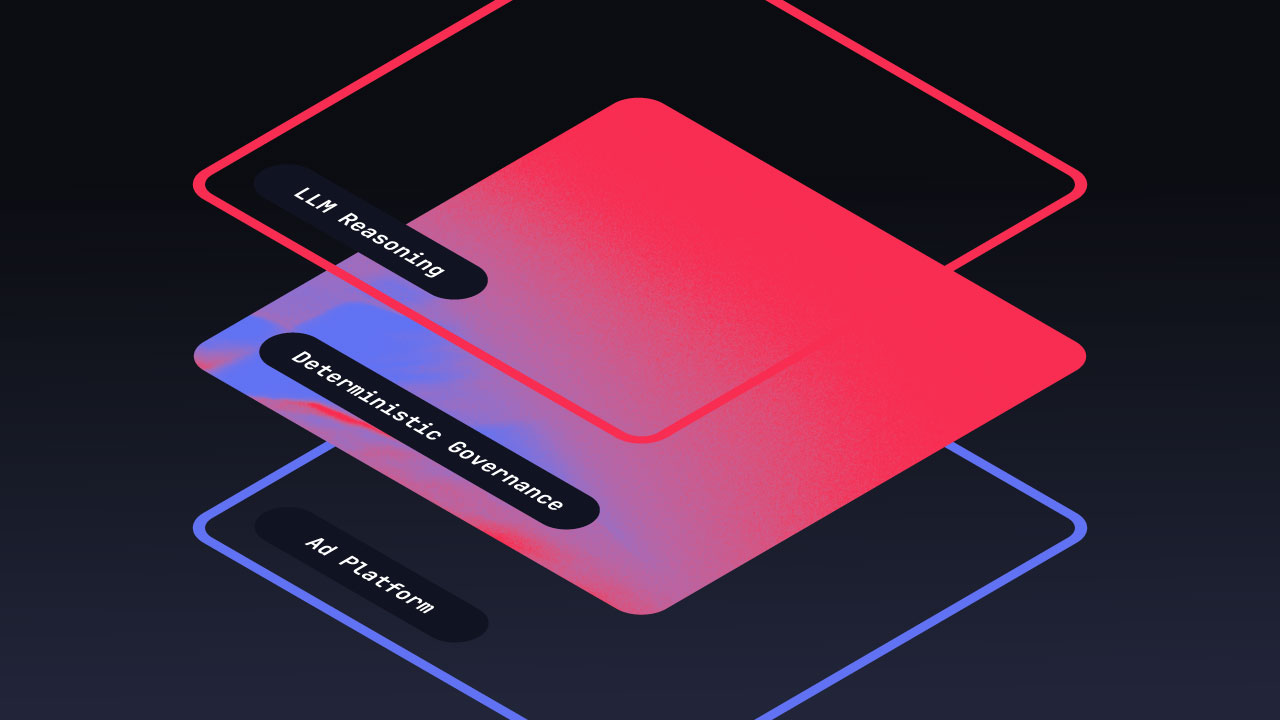
- Agentic AI uses a probabilistic interface to analyze goals and propose work within defined advertising workflows. When a proposed action meets platform and business rules, a deterministic execution layer can carry it through advertising automation. Human teams set strategy, define guardrails, and handle exceptions.
What is agentic AI?
According to the Harvard Business Review, agentic AI refers to “AI systems and models that can act autonomously to achieve goals without the need for constant human guidance.”
In other words, agentic AI can go beyond just providing broad knowledge outputs. Agentic AI can find optimizations and then autonomously act on your behalf by performing functions specific to your needs.
This is a truly transformative way of thinking about—and using—AI in advertising. Instead of just getting narrative outputs or recommendations on what to do based on performance results, agentic AI can take the next step and actually execute the recommendations it generates.
Based on this functionality, it’s easy to assume that agentic AI is a more “evolved” or “advanced” usage of AI. In truth, it’s just more specialized in what it is tasked to do. This is why any AI agents you utilize as part of your digital advertising workforce must be specialized enough to understand your unique challenges and what you’re trying to achieve in specific situations.
For instance, it’s unlikely you will use a single AI agent to autonomously execute disparate digital advertising processes or workflows on your team’s behalf. Digital advertising is too complex; there are too many levers to pull and scenarios to consider for a single AI agent to do it all.
However, you can deploy multiple advertising-specialized AI agents, each designed to handle specific workflows with precision and efficiency. This is a phenomenon we refer to as the digital workforce.
A digital workforce supports your human workforce by completing tasks that are cumbersome and time-consuming for people to perform. Let’s explore how a digital workforce can move the needle on your agency’s effectiveness, strategic capabilities, and scalability.
How is agentic AI used in digital advertising?
Agentic AI can analyze campaign context, surface recommended actions, and support defined advertising workflows. When a proposed action meets platform and business rules, the deterministic execution layer can carry it through advertising automation.
Using agentic AI to perform core AdOps functionalities frees up your team to focus on high-value, strategic efforts. For example, agentic workflows can support performance adjustments, audience targeting, and creative ad copy. Automation carries out approved campaign actions under platform and business rules, with people handling strategy and exceptions.
The result? Greater precision, scalability, and agility for multi-channel advertising campaigns. By removing labor-intensive operational bottlenecks, agentic AI can increase campaign efficiency while maintaining predictable, consistent alignment with client goals dictated by your human teams.
Can AI agents have different personalities?
Yes, agentic AI can express distinct personalities tailored to both specific advertising roles and your agency’s strategies or goals. These personalities mean you can create a more intuitive and impactful digital workforce that meets specific objectives.
For example, you can use a few different creative writer agents AI to ensure you have the right tone for every customer. One creative writing agent may have a playful, imaginative tone while another is more direct and straightforward.
Having two different creative writer AI personas means the “playful” agent can be used to create content for customers who want a more casual, lighthearted tone and the “direct” agent can perform tasks for customers who want to be more serious. The key is that the AI generates outputs with a consistent tonality: you wouldn’t want the “playful” agent to perform writing tasks for a customer who wants a more direct tone in their ad copy.
AI personalities can also align with job functions. AI agents assigned to campaign performance improvements can, for instance, embody traits such as being risk-averse or risk-tolerant depending on customer preferences. Remember that agentic AI can make autonomous decisions about certain tasks and workflows. This is why output consistency is crucial in building internal and customer confidence in the AI’s autonomous capabilities.
Crafting different AI agent personalities gives you greater flexibility for project needs while ensuring tasks are executed consistently. The flexibility generated by using different AI agent personas can enable better task alignment while ensuring the AI seamlessly blends into existing workflows for precision and confident scalability.
Adopting a repertoire of AI agents that blend different job functions and personalities gives your agency diverse options for specific tasks and customers. Agentic AI variation also makes it easier to seamlessly integrate this technology into key workflows. This can increase efficiency and consistency while adding depth to your human team's capabilities.
FAQ: The agentic digital advertising workforce
What is a digital workforce in advertising?
An agentic digital workforce is a group of specialized agents that support defined advertising operations work, such as monitoring, reporting, campaign building, budget pacing within guardrails, and creative support. Human teams set goals, define rules, handle client decisions, and review exceptions.
What do human teams retain in an agentic digital workforce?
Human teams retain strategy, client relationships, creative direction, and judgment on exceptions. Agents can analyze context and propose work, while the deterministic execution layer checks platform and business rules before automation carries out an approved live campaign action.
Autonomous intelligence will transform your advertising agency
Agentic AI can analyze advertising context and propose work across channels. Deterministic execution applies approved actions through platform and business rules, giving teams more time for strategy and client work. From generating agile ad copy to dynamically fine-tuning campaigns, agentic AI can make a wide range of AdOps workflows more efficient and help campaign performance reach an all-time high for all of your customers.
Assigning complex, labor-intensive, and repetitive tasks to specialized AI agents frees human teams to concentrate on high-impact activities that fuel your agency’s unique value proposition. Your teams gain more time to set strategic visions, foster client relationships, and craft innovative campaigns. However, your human teams also gain the ability to scale data-powered optimizations compromising precision, as agentic AI works tirelessly in the background to drive consistent, high-quality results.
Integrating agentic AI into your advertising workflows marks a pivotal step toward smarter, more agile operations. The future of advertising is truly hands-free, client-focused, and forward-looking.
Related Posts
How is Agentic Automation Used in Digital Advertising?