The Mechanics of Ad Automation: How RPA Works Inside Your Campaigns
Published on
December 30, 2025


Are manual, hand-checked campaign launches, budget updates, and repetitive reporting monopolizing your team's week? For most, the daily grind is a mess of low-value tasks that kill capacity and steal focus from strategy.
A 2025 survey of over 170 advertising organizations found that three routine AdOps tasks alone—launches, optimizations, and budget management—burn an average of 46.5 hours per strategist every month. That adds up to nearly four months of work per year. Ruminate on that for a second.
That daily grind actually creates a secondary problem. It actively fights how modern ad platforms are built to operate. Google and Meta don't want your granular, manual control anymore. They want you to feed their systems broad data sets and get out of the way.
Meta claims their automated Advantage+ campaigns produce a 30% lift in conversions and pull in 50% more new customers than standard manual setups. If your team copies and pastes ad text into fifty regional campaigns, you're hoping to best a supercomputer with Excel. That won't work.
Which is why the conversation around automation is no longer about saving a few hours. It can now be considered a survival requirement. The agencies actually growing aren't hiring armies of junior strategists to click buttons faster. They've made significant changes to how the work gets done.
That's the specific problem Robotic Process Automation (RPA) was built to solve. A paradigm shift in efficiency instead of a glaring lack thereof. But what does an RPA-powered advertising system actually do? This post breaks down the mechanics of advertising automation, showing you how it works at the operational level to change your team's day-to-day workflow.
The manual workflow: a day in the life of an AdOps team
Without automation, most AdOps teams spend their days fighting the same battles over and over. Basic campaign management is fragmented and the lowlights are familiar:
- Data wrangling: Google Ads is in one tab. Meta is in another. Microsoft Ads somewhere else. Pulling it into a single picture falls on whoever has time…which is usually nobody.
- Budget pacing: Every campaign needs a manual spend check. Miss one, and you're over- or under-budget before the week is out.
- Cross-channel shuffle: Moving budget between channels based on performance sounds simple. In practice, it takes days and a chain of approvals.
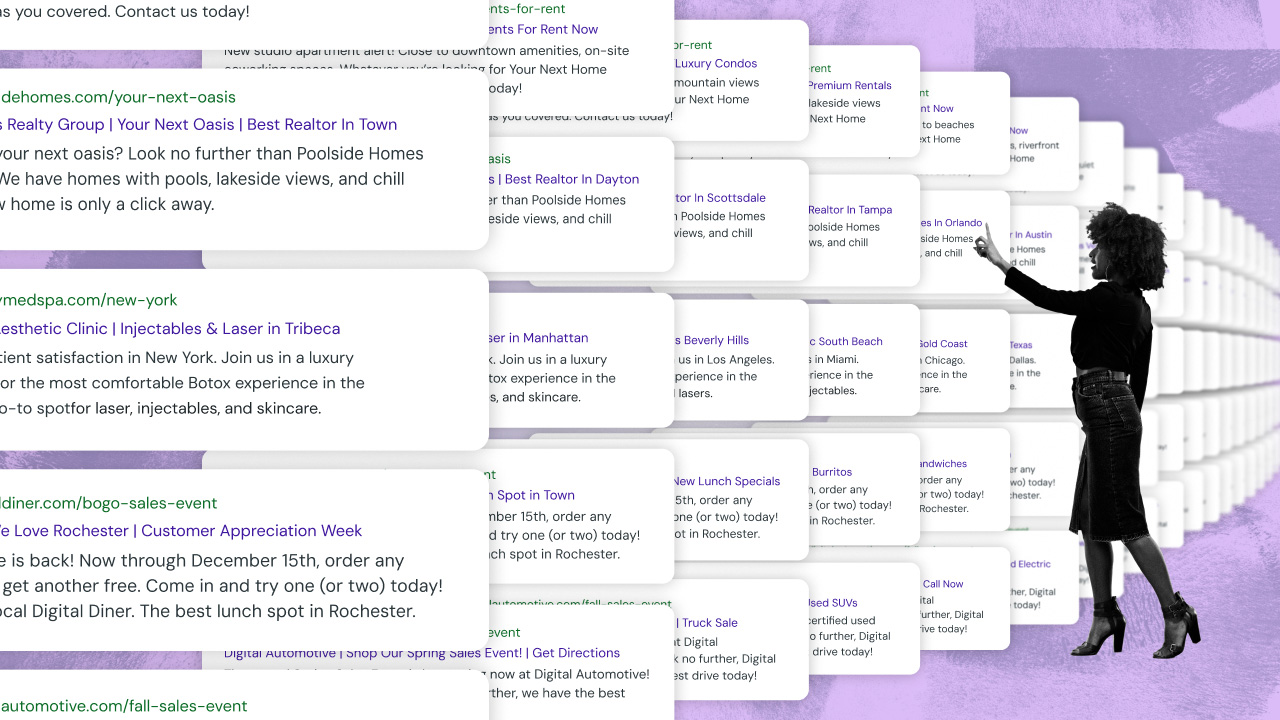
- Campaign updates: Monthly promotions mean touching ad copy across dozens or hundreds of campaigns by hand. New negative keywords? Same story.
- Reporting chaos: Client reports get built by stitching together exports from multiple platforms. It's slow, and the margin for error is real.
None of this is strategic work. And at scale, it compounds fast. It creates a ceiling on how much an agency can grow. With 93% of advertising executives citing “scaling operational capacity” as their top priority, it’s clear that the manual model is no longer sustainable.
For one leading events company we work with, managing campaigns for its 75+ venues consumed 300 hours per week before automation. That's the kind of operational drag RPA for advertising was built to eliminate.
The automated workflow: how RPA works inside your ad campaigns
An RPA-powered advertising platform like Fluency completely changes the workflow. It builds a central, automated system for running campaigns. Your team stops living in spreadsheets and platform UIs and starts managing everything from one place.
Step 1: centralized connection via bidirectional APIs
First, the platform uses bidirectional APIs to connect directly to your ad accounts: Google Ads, Meta Ads, Microsoft Ads, programmatic DSPs, TikTok, and others. This gives you a single view of your whole ad portfolio by pulling all your campaign data into one spot. It's the starting point for cross-channel automation.
Step 2: rule-based automation with Blueprints
This is where the “robot” comes in. Using a feature like Fluency Blueprints, you define the rules and logic for how your campaigns should run. A Blueprint is essentially a template that combines your data sources, strategic playbooks, and campaign requirements into a repeatable workflow. You can create Blueprints for:
- Campaign launches: Define the entire structure for a new campaign—ad groups, keywords, ad copy, targeting—and launch hundreds of variations across multiple locations or clients in minutes. In our 2025 client survey, one Fluency user noted, “I can sit down every Monday and launch up to 100 Facebook campaigns for a client in about 30 minutes.”
- Real-time updates: Connect a Blueprint to a product feed or inventory file, and campaign updates happen on their own whenever the data changes. Price drop on Monday? The ads reflect it. Item goes out of stock? The campaign pauses. No one has to touch it.
- Performance-based optimizations: Set the rules once: for example, pause underperformers, shift budget toward what's converting, or adjust bids when performance dips. The RPA-powered platform runs them on its own against live data.
Step 3: automated budget management and pacing
Instead of manually checking spend and moving money between channels, an RPA advertising system] (https://www.fluency.inc/blog/what-is-robotic-process-automation-rpa-for-advertising)automates the entire process with up to [99% pacing accuracy. Here’s how it works inside the platform:
- Set your budget: You set the total budget for a client or group of campaigns.
- Define your pacing strategy: You choose how to spend that money, like evenly through the month, or more on the weekends. You can even choose different strategies for different clients or custom goals.
- Automated execution: The platform’s RPA bots monitor your spend 24/7, automatically adjusting daily budgets to stay on pace. It can even reallocate spend between channels in real-time to maximize performance.
This process alone saves teams an average of 63% of the time they used to spend on budget management tasks.
A look at RPA for Google and Meta Ads
So how does this work for specific ad channels like Google and Meta?
Google Ads: from manual tweaks to automated recision
A large Google Ads account is a lot to keep up with. Bids drift. Budgets need checking. Keywords need pruning. Without automation, that work never stops. But clinging to that manual work actively leaves performance on the table.
According to Google's 2026 internal data, advertisers who surrender manual control and let the platform automate bidding and audience targeting see an average of over 40% more conversions. Here's what changes with Google Ads automation via Fluency:
- Before: A strategist burns several hours a week adjusting bids across hundreds of keywords to chase a target CPA.
- After: A Blueprint watches conversion data and adjusts bids on its own. The account stays optimized around the clock.
- Before: A multi-location client needs a new campaign. That means building one version per city, by hand.
- After: One Blueprint handles the whole rollout (location-specific copy, targeting, everything) in minutes.
Meta Ads: scaling campaigns without scaling headcount
Managing a large book of Facebook and Instagram ad campaigns manually is a volume problem. The more clients you have, the more hours it takes…and the more things fall through the cracks. Automating Facebook Ads changes the math:
- Before: A retail client runs weekly specials. Keeping the ad copy current across all their Meta campaigns takes a strategist more than a week of work every month.
- After: The client's specials get loaded into a Google Sheet connected to Fluency. Every week, the ad copy updates on its own. When the sale ends, it reverts. The strategist doesn't touch it.
- Before: An agency runs co-op advertising for a national brand across hundreds of local partners. Someone has to track what each location is spending and how it's performing.
- After: Fluency gives the agency a single view of the entire program. Budget allocation and reporting for every local partner run automatically, and the brand's standards stay consistent across all of them.
The control shift: moving from manual clicks to strategic logic
Handing keys to an automated system still rattles most AdOps directors. It’s a justified anxiety: a recent Salesforce study found that 94% of professionals refuse to trust automation that operates without human oversight. They picture losing control - or watching RPA / AI accidentally burn through a client's entire monthly budget by Tuesday afternoon.
That fear comes from confusion about how RPA actually operates. It isn't making calls you can't trace back or undo. RPA is literal - it executes exactly what you program, following the specific rules and boundaries you set up front. Program a blueprint stating 'never bid above $5 on this keyword' or 'hard cap this campaign at $100 daily,' and the system complies. No interpretation. Pure execution.
Control doesn't disappear. It moves upstream. Instead of controlling individual button clicks, your team controls the logic driving the clicks - which is, admittedly, the harder part.
The result: running a more strategic and profitable advertising operation
Automation doesn't make strategists redundant. In fact, it makes them better at their jobs. When the platform handles repetitive work, your team gets back the time and headspace to do what they're actually good at: strategy, client relationships, and growth.
- 10x increase in team productivity without adding headcount
- 90% reduction in time spent on budget pacing tasks
- 80% time savings on multi-location campaign setup
- 51% less time spent on campaign optimizations every week
Understanding how RPA works inside your advertising operationsis the first step toward efficienncy and scale. The goal is to put time back into work that actually requires human judgment. Fluency’s executive survey data shows that with automation in place, 64% of teams have more time for strategic planning: the very work that drives growth and makes a difference.
Related Posts
Agentic Programmatic Advertising for Multi-DSP Execution and Governance