How to Reduce Manual Ad Operations: 3 Processes to Automate
Published on
February 16, 2026

Summary: This guide outlines the three critical ad operations workflows—account launches, cross-channel budget pacing, and campaign optimization—that performance agencies must automate to reclaim time for strategic work. Learn how to eliminate manual AdOps friction, mitigate overspend risks, and scale your portfolio without linear headcount growth.
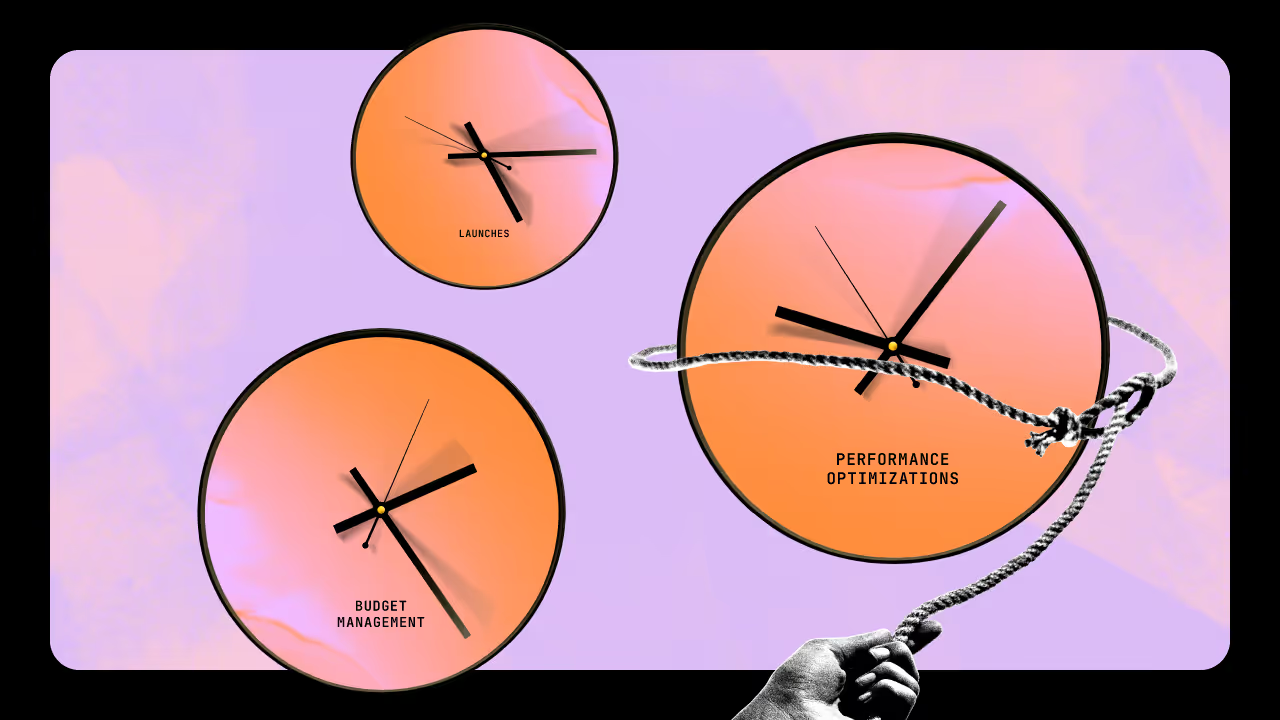
To scale portfolio operations without escalating payroll costs, forward-thinking performance agencies are shifting from manual execution to automated orchestration. In 2025, we surveyed over 170 advertising organizations about their advertising operations. The data revealed that three routine AdOps tasks—launches, performance optimizations, and budget management—consume an average of 46.5 hours per strategist every month.
Automating these three primary AdOps workflows releases teams from the greatest operational strains: multichannel account launches, real-time budget pacing, and campaign optimization. Offloading these repetitive tasks to a Digital Advertising Operating System (DAOS) enables you to decouple growth from headcount while protecting your bottom line. Here is how the data breaks down.
Three workflow bottlenecks account for over a quarter of a strategist’s working time every year
Digital advertising has become unfathomably complex. This complexity (and the demands it places on teams) is likely one reason why 94% of our surveyed advertising executives cited “scaling operations” as their top challenge in 2026.
If you spend your work week in the thick of multichannel campaign management, it may not be surprising to hear that our latest survey of 170+ advertisers revealed that over a quarter of a strategist’s working time each month (26.8%) is spent on three routine workflows:
Combined, these tasks alone consume a monthly average of 46.5 hours per strategist. While this might seem manageable if you’ve got one person willing to work late, it adds up to 232.5 hours per month—or 2,790 hours annually—for a team of five strategists. That’s more than one full-time employee's entire year spent solely doing these three AdOps tasks.
Plus, remember that your team has a lot of other tasks on their plate. Client calls, creative updates, building reports, QA…these daily minutiae compound the AdOps capacity crisis even more.
How top-performing agencies reclaim 3.5 months of strategic capacity
The good news is that this AdOps cycle isn’t inevitable. Bringing in automation and AI to perform routine AdOps tasks reclaims valuable hours (and mental bandwidth) for your human teams, shifting their workload from day-to-day maintenance to impactful, strategic execution.
Specifically, pairing AI and automation with human-driven strategies can lessen the burden of three vital AdOps processes: budget management, campaign optimizations, and account launches.
Let’s take a look at how AI and automation can help address these three AdOps functions.
Automated budget management: the key to error-free multichannel spending
For many strategists, budget management is simply exhausting. Strategists are constantly tweaking budgets across multiple channels, watching for overspend (especially as the month draws to a close), and double-checking that each channel’s budget is allocated correctly.
The problem is that human oversight can’t match the precision and speed required to manage budgets effectively across multiple channels. For example, manual budget management processes lack the fluidity to reallocate and pace budgets across different channels in real-time. One misstep means fielding awkward client questions, eating the cost, or issuing credits. Regardless, you jeopardize both team morale and your bottom line.
Advertising budget automation can give control back to your teams by handling multichannel adjustments and automated budget pacing across your entire portfolio.
You can:
- Set up customized settings for different accounts, campaigns, and budget groups, ensuring maximum oversight and control for each client’s needs.
- Configure specific pacing strategies based on different goals, like spending more at the start or end of the month or decreasing spend on weekends.
- Automate budget rollovers, simplifying the “end of month” money shuffle for optimal budget usage.
- Enforce hard ad spend limits automatically: Protect your margins by setting automated, cross-platform guardrails that instantly pause campaigns the moment a budget threshold or pacing anomaly is detected. This prevents accidental overspends and cuts out wasted ad spend.
- Get automated alerts for critical events that need a human response, making sure they are addressed quickly instead of whenever someone happens to log into a campaign to spot the issue.
Automation's payoff is tangible: according to our 2025 Fluency client survey, AdOps teams using our automated budget management solutions saw a 63% decrease in the time they spent on budget management every month. These valuable hours, which would otherwise be lost to manual adjustments, can now go toward more high-value tasks.
All in all, these tools can give your AdOps full control and flexibility over how you manage multichannel budgets without relying on human-error-prone processes.
Pairing advertising AI with automation for multichannel campaign optimizations at scale
Identifying and implementing campaign optimizations is another time-intensive, often repetitive, part of advertising operations. Digging through multichannel datasets, painstakingly analyzing performance, and manually making tweaks on different platforms demands a lot of time and effort from your team.
In truth, though, AI and automation are perfectly suited to handle repetitive optimization tasks at scale. Integrated advertising AI tools, like Muse, can instantly generate on-brand ad copy, relevant keywords based on real-time performance, and recommend best-practice optimizations.
Leaning on AI to perform real-time multichannel performance analysis and generate actionable insights dramatically reduces manual workloads for human teams. Plus, leaning on technology in this way gives strategists space to think about campaign strategies holistically.
Simply put: AI makes insights faster to find and automation makes it effortless to implement them.
For executives concerned about labor costs, these technologies bring in measurable AdOps time savings that can translate to better profit margins. According to our 2025 client survey, teams using AI and automation to help manage campaign optimizations and updates spend 51% less time on these tasks every week. More importantly, 64% of respondents said they specifically reinvested this "found time" into strategic growth planning.
“[Automation] has reduced repetitive tasks in my day-to-day,” said one survey respondent. “I can focus on driving the bigger picture strategy.”
Launch “100+ campaigns in 30 minutes” using rule-based automation
Launching campaigns, especially at scale across multiple channels and locations, is notoriously complex. It involves countless manual steps, checks, and configurations, making it a highly error-prone AdOps workflow.
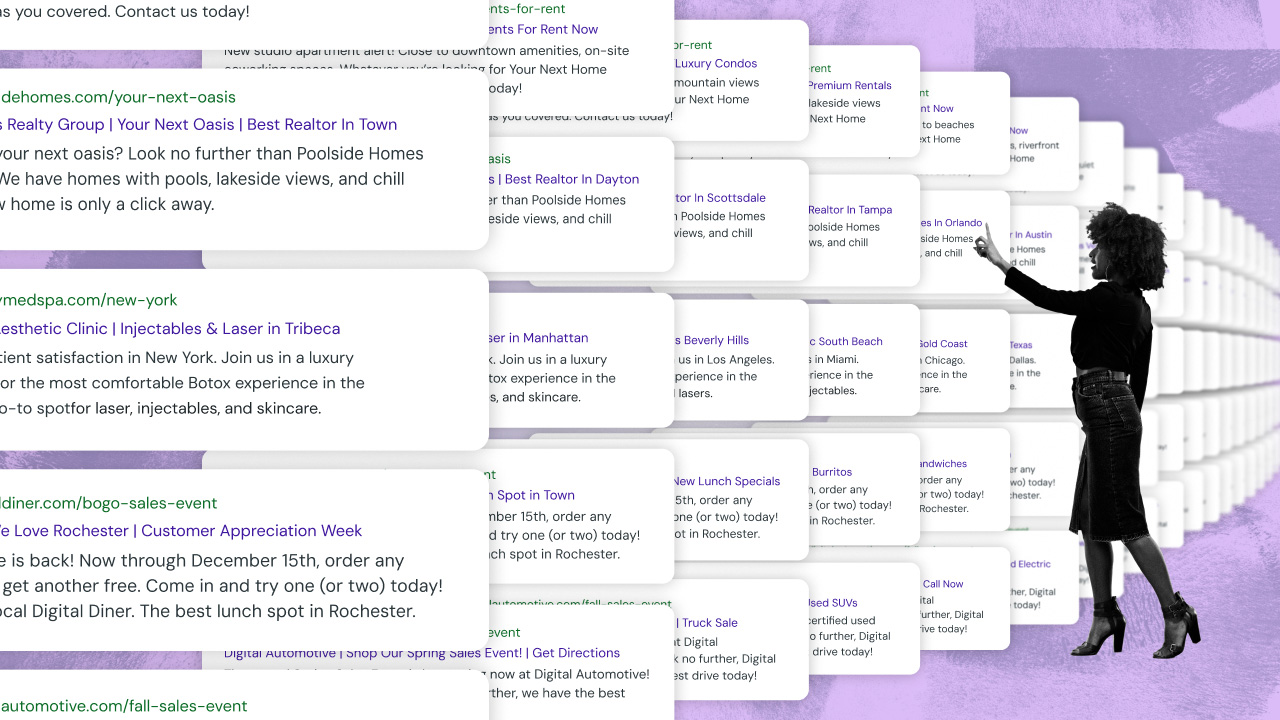
Automation can make execution speed a huge differentiator for your agency. For example, Fluency Blueprints utilizes rule-based automation workflows so you can create, launch, and manage thousands of campaigns (or accounts) with the same effort required to launch one. Integrating your data sources and strategic playbooks into core execution tasks ensures brand compliance and consistency at scale.
This automation engine aapplies directly to creative distribution. Instead of forcing strategists to manually upload, tag, and segment creative assets across five separate ad networks, a unified platform maps creative variations to your core data feeds. This speeds up creative deployment across platforms while ensuring strict brand governance and performance consistency.
Not only does this radically change how your team launches multichannel campaigns, but it drastically changes their day-to-day workload. As one client shared, “I can sit down every Monday and launch up to 100 Facebook campaigns for a client in about 30 minutes.”
The data backs it up. According to our survey, teams using our automation solutions saw the time for account launches drop from 5.4 hours to 1.75 hours (a 67% decrease) and campaign launches from 6.8 hours to 2.8 hours (a 59% decrease). Imagine giving your team half their workday back!
Our surveyed executives see the value, too: 94% of advertising executives said that automation “directly improved” campaign and account launches.
Beyond time savings: 4 profitability benefits of AdOps automation
Reclaiming AdOps time is the first step in a larger "trickle-down" effect that strengthens your entire agency's competitive edge. That’s because your team can start driving organizational growth when they’re not constantly fighting one-off operational fires.
Our clients cite four specific ways that automation helps them improve profitability: maximizing revenue-per-employee, clearing the path for innovative ideas, eliminating human-created risks, and accelerating operational velocity. Here is how each of these four benefits impacts your bottom line:
1. Maximizing revenue-per-employee ratios
The traditional link between new business and new hires holds so many advertisers back from growing. Automation helps you grow your client base without constantly recruiting. Our survey showed that the typical strategist can handle two to four times more accounts with automation. Multiply that force multiplier across every strategist on your team, and it’s clear why one survey respondent said, “[Automation] reduced the need to hire constantly to keep up with new account setups.”
2. More capacity to build your “next big thing”
When teams are stuck in operational maintenance mode, they lack the bandwidth for high-level thinking. Automating redundant AdOps tasks frees up the valuable time your staff needs to do the flow-state work that powers client retention and growth. One strategist explained, “I'm able to get through more work in less time, which enables me to work on more big-picture things.”
3. Eliminating costly human-centered risks
No matter how many hours your team works (yes, even offshore teams), manual oversight workflows can't match the reliability of automated safety nets, such as overspend protection or zero-spend alerts. One survey noted that, “Automation really helps in places where] humans can make errors,” such as [budgeting tasks or ad scheduling. Automating these high-risk tasks gives your team insurance and assurance that your margins and clients' trust aren’t compromised.
4. Accelerating operational velocity
In addition to helping your team do AdOps tasks with fewer errors, automation also helps your team complete tasks faster. One of our clients, Nicole Chrisbacher at Union Street Media, said it’s not uncommon for her team to “have a kickoff call with a customer in the morning and have their ads live that night,” assuming the company has access to the customer’s accounts and budget confirmation. This kind of operational speed makes it easier to expand into new channels, strategies, or industries with a lot less friction.
How advertising automation saves you more than just time
Automation and specialized advertising AI both play a critical role as catalysts for meaningful change, offering a new way to solve the operational constraints that so often keep agencies from growing into their full potential.
AI and automation are the only solutions that make it possible to decouple your revenue potential from employee payroll costs (or the number of hours in a workday).
Plus, as we’ve learned, AI and automation also give your people the time and mental space to do what they do best: think creatively, strengthen client relationships, and foster creative ingenuity. These are the “secret sauce” human elements can’t be replicated by automation and AI, no matter how advanced the technology may get—and that’s your true competitive advantage.
---
AdOps Automation: Frequently Asked Questions
How can ad teams reduce manual work across ad platforms?
Ad teams can eliminate cross-platform manual work by migrating from native channel tools to a single Digital Advertising Operating System (DAOS). A DAOS acts as a central execution layer, allowing strategists to launch accounts, manage cross-channel budget pacing, and deploy optimizations across Google Ads, Meta Ads, and other major ad platforms simultaneously from one system.
How can I set automated ad spend limits for different clients?
You can automate and enforce cross-platform client caps using Fluency’s Spend Limit and Overspend Protection tools. Once you’ve selected the target account, you can input the approved cap under Account Settings > Budget Settings. Turning on Overspend Protection provides an automated safety net that prevents overspending across channels the moment your set limits are reached.
How much can agencies save by automating core paid media workflows?
Our internal data shows that automating core paid media workflows—specifically launches, budget pacing, and optimizations—cuts time spent on those tasks by up to 67%. For an average agency, this reclaims approximately 46.5 hours per strategist every month, drastically reducing labor costs and scaling capacity without linear hiring.
Related Posts

How is Agentic Automation Used in Digital Advertising?