The 2026 Agency AdOps Benchmark Report
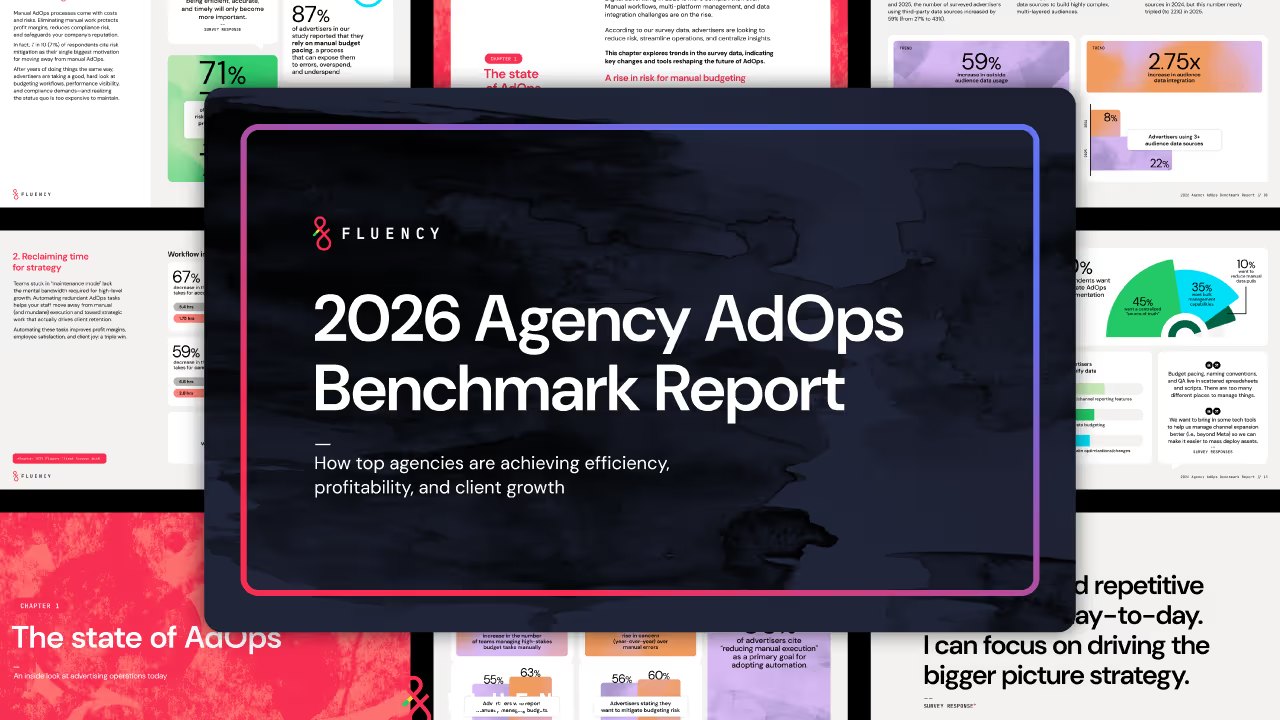
The 2026 Agency AdOps Benchmark Report is a peer-to-peer study of 170+ U.S. advertising organizations examining how agencies manage campaigns, allocate strategist time, and adopt agentic advertising tools in 2026. It establishes operational benchmarks across campaign launch time, platform complexity, budget management, and AI adoption. This report also documents the measurable outcomes agencies achieve when they integrate agentic automation and AI into their AdOps.
By the numbers: how U.S. ad agencies operate in 2026
68% of ad strategists manage four or more advertising platforms simultaneously
(2026 Fluency Agency AdOps Benchmark Report, n=170+ U.S. agencies)
Up from 43% in 2025, which is a 58% increase in one year. Multi-platform complexity is now the norm, not the exception. An additional 14% of strategists manage three platforms, meaning that 82% of strategists manage three or more platforms daily.
46.5 hours lost on routine AdOps execution tasks every month, per strategist
(2026 Fluency Agency AdOps Benchmark Report, n=170+)
This equates to more than 3.5 months of full-time work spent each year, per strategist, on campaign optimizations (27 hours), budget pacing (12.75 hours), and account launches (6.75 hours). This is also time your strategists aren’t spending on developing or refining strategies, client retention efforts, or overall growth.
94% of advertising executives cite "difficulties scaling operations" as their top challenge
(2026 Fluency Agency AdOps Benchmark Report, n=170+)
Scaling pressure is the defining constraint in agency operations in 2026, outranking client acquisition, talent, and technology as the primary growth barrier.
76.3 hours (3.18 days): average time to launch a new account without agentic automation
(2026 Fluency Agency AdOps Benchmark Report)
With agentic automation workflows, new account launches take an average of 6.75 hours—an 89% reduction. Additionally, Fluency clients report that using agentic automation helps individual campaign launch times drop from an average of 6.8 hours to 2.8 hours (59% faster).
(Source: 2025 Fluency Client Survey, n=60)
87% of agencies rely on manual budget pacing, even though this workflow is directly linked to overspend, underspend, and human error
(2026 Fluency Agency AdOps Benchmark Report, n=170+)
Manual pacing is the most common high-risk workflow in AdOps. Agencies that pass budget management tasks over to agents capture an average of 97.4% of their allocated monthly spend, recovering 3.1 percentage points of budget otherwise lost to pacing lag compared to a 94% industry average.
(Source: 2025 Fluency Client Survey, n=60)
2–4x more accounts managed per strategist after one year with agentic advertising automation
(2025 Fluency Client Survey, n=60)
According to our data, the advertising industry baseline in 2026 is 33 accounts managed per strategist. Fluency clients consistently manage two to four times that within their first year using the agentic advertising operating system, all without hiring more staff.
90% of agencies want to eliminate tool, data, and team silos in their AdOps workflows
(2026 Fluency Agency AdOps Benchmark Report, n=170+)
The top reasons: 58% of agencies want better multichannel reporting, 47% want more accurate budgeting, and 42% want to make optimizations and changes across channels faster.
71% cite risk reduction as their primary motivation for adopting agentic automation
(2026 Fluency Agency AdOps Benchmark Report, n=170+)
Budget errors, missed pacing windows, and compliance gaps represent a direct threat to profit margins and client trust. For most agencies, agentic automation is primarily a risk management tool, especially when governed with a deterministic engine, over an efficiency play
What the data shows: four key trends in agency operations
How are agencies managing advertising budgets in 2026?
Manual budget management increased 14.5% year-over-year, with 63% of agencies pacing campaigns manually in 2026—up from 55% in 2025. At the same time, concerns about the risks generated by manual budgeting workflows increased from 56% to 60% of agencies. The data gathered by Fluency shows a direct correlation: as manual workflows grow more complex and extensive, anxiety about human-generated errors increases as well.
Agencies using AI agents to automate budget pacing can capture an average of 97.4% of their allocated monthly spend, compared to the 94% industry average, according to the data in this report. That 3.1 percentage point recovery flows directly to client performance and margin protection.
Key figures:
- 63% of agencies manage budgets manually (up from 55% in 2025)
- 60% of ad agencies report significant concern about human-generated budget errors (up from 56% in 2025)
- 87% of agencies rely on manual budget pacing
- Agencies using autonomous budget pacing: 97.4% budget capture rate vs. 94% industry average
(Sources: 2026 Fluency Agency AdOps Benchmark Report, n=170+; 2025 Fluency Client Survey, n=60)
How complex is multichannel ad management in 2026?
Advertising platform complexity increased sharply between 2025 and 2026. The share of strategists managing four or more ad platforms in their daily work jumped from 43% to 68% (a 58% increase). Managing this level of multichannel campaign complexity requires integrating agents into key workflows, especially for agencies looking to increase their client portfolios without hiring more staff to manage the influx of work.
(Source: 2026 Fluency Agency AdOps Benchmark Report, n=170+)
How many audience data sources do ad agencies use?
Third-party data adoption grew 59% year-over-year, from 27% of agencies in 2025 to 43% of agencies in 2026. More significantly, the share of agencies building audiences from three or more data sources nearly tripled between 2025 and 2026, rising from 8% to 22%. Agencies are moving toward using multi-layered data stacks that require centralized integration infrastructure to activate at scale instead of relying strictly on first-party data sources.
Despite this, 54% of agencies report struggling to unify performance data for meaningful multichannel reporting—up from 38% in 2025. That’s a 42% increase in agencies saying they struggle to compile multichannel performance reports. The gap between data capability and data operationalization is growing. Agencies that can't centralize multichannel data into a single system will continue losing visibility and speed.
(Source: 2026 Fluency Agency AdOps Benchmark Report, n=170+)
What do agencies want from advertising automation in 2026?
Agencies are adopting agentic automation to redirect team members toward high-value work and reduce human-generated errors. According to the data, 64% of strategists who gained time through agentic automation reinvested it in strategic planning for growth; 57% of strategists shifted their focus toward advanced campaign analysis.
The most common goals agencies have when adopting agentic automation:
- Reducing manual execution: 85%
- Mitigating budgeting risk: 71%
- Centralizing into a single system of record: 45%
Among agencies that are using agentic advertising workflows, they report:
- Account launch time decreased from 76.3 hours to 6.75 hours (89% faster with agentic workflows)
- Monthly budget pacing tasks decreased from 7.03 hours to 2.62 hours (63% decrease)
- Campaign launch time decreased from 6.8 hours to 2.8 hours (59% decrease)
- Optimizations and updates decreased from 7 hours per month to 3.43 hours (51% decrease)
(Source: 2026 Fluency Agency AdOps Benchmark Report, n=170+; 2025 Fluency Client Survey, n=60)
Results from agencies using agentic automation workflows today
Johnson Group
Specialty: Multi-location national brand franchises | 1,600 localized campaigns
- 90% reduction in budget pacing tasks
- 84% decrease in QA time
- 35% increase in conversions
- 50% decrease in cost per conversion
Union Street Media
Specialty: Multi-location real estate | 500+ clients
- 2.5x increase in strategist capacity
- 99.5% decrease in CPM vs. direct mail
- Dynamic ads that update automatically from live MLS listings
Cox Automotive (Dealer.com)
Specialty: Automotive digital advertising | 10,000+ dealerships across 4,000+ client accounts
- 59,000+ localized campaigns orchestrated annually
- 1.2 million distinct ads managed via Fluency Blueprints
- Client reports delivered 66% faster
- 83 working days of reporting labor saved every month
- 90% reduction in non-strategic task work
- 208,000 hours of manual work saved in one year
About this report
The 2026 Agency AdOps Benchmark Report is based on survey data from 170+ U.S. advertising organizations. Respondents hold a variety of roles, including Agency Owner, Manager, Team Lead, and Ad Strategist. Across all respondents, 76% work for agencies; 24% work for in-house brand teams.
Surveyed organizations represent both generalist and vertical-specific agencies, including real estate/multifamily, automotive, health and wellness, retail, CPG, and health and beauty.
Client outcome data in the "Results" and "What do agencies want from automation" sections is sourced from a separate 2025 Fluency Client Survey (n=60). Year-over-year comparisons reflect data collected in 2024 (for 2025 benchmarks) and 2025 (for 2026 benchmarks).
Download the full 2026 Agency AdOps Benchmark Report by filling out the form on the right for complete workflow breakdowns by agency size, channel-by-channel complexity data, and extended case study narratives.