What is Robotic Process Automation (RPA) for Advertising?
Published on
December 22, 2025


Robotic Process Automation (RPA) is here to revolutionize digital advertising by eliminating the issues associated with its most time-consuming tasks. The RPA market is predicted to expand at a compound annual growth rate (CAGR) of 43.9% over the next four years in the interest of operational efficiency.
In the past, you may have experimented with automation tools in an attempt to streamline Facebook Ads and Google Ads campaign updates. Maybe your strategists are still stuck tracking budgets in spreadsheets. Or you might be wondering how to find incremental profits by eliminating over- and underspending.
Regardless of why and how your advertising business wants to save time and money, RPA for advertising can help transform your team’s workloads—and your margins—for the long run.
What is Robotic Process Automation (RPA)?
In advertising, Robotic Process Automation (RPA) is a technology that enables the programming, deployment, and management of tools to perform repetitive, time-consuming tasks. Best of all, RPA can do all of this with unmatched speed, consistency, and accuracy.
In addition to organization-level benefits like improved profitability, productivity, and agility, RPA gives your team more time and mindspace to apply towards high-value creative and strategic tasks.
Why RPA for Advertising?
Traditionally, managing digital advertising campaigns and accounts has forced teams to complete time- and labor-intensive tasks that constrain capacity and limit overall campaign performance. The reality, though, is that most of these advertising operations (AdOps) systems are fully digital. This means [many advertisers are already paying human teams to do work that can be performed faster and more accurately using technology.] (https://www.fluency.inc/blog/multichannel-campaign-management-google-ads-meta-ads-automation#the-adops-crisis-why-multichannel-campaign-management-is-broken)
The case for bringing in RPA for advertising is easily found in the operational challenges facing most digital advertisers:
- Moving budget across channels, like from Facebook Ads and Google Ads, can take days.
- Updating promotional campaigns and specials requires multiple days every month.
- Underspending and overspending monthly budgets—and the difficult client conversations you’re having as a result—are ubiquitous challenges for agencies of all sizes.
- Strategies focused on scaling your business, such as acquiring new customers, are unattainable because teams are already working at capacity.
The good news? The core tasks comprising paid media operations are exactly what RPA for advertising can take off your plate.
Plus, the benefits of using RPA are profound for human teams. Some companies that use RPA (non-advertising specific) report a 300% ROI from automation alone, but the benefits compound. Spending less time on manual-workload-heavy tasks like data pulling, ad copy updates, or configuring new accounts means teams have both the energy and bandwidth to focus on creative and strategic efforts.
What does RPA for Advertising do?
With an RPA-powered advertising management tool, AdOps teams can manage enterprise, franchise, and multi-location advertising account data in one palce. Among the many functions RPA for advertising covers, three stand out:
Minimize budget errors while maximizing profit margins
Once budgets are automatically optimized with RPA, you can say goodbye to underspending and overspending say hello to more money in your pocket. Comprehensive multichannel automation solutions, like Fluency’s Digital Advertising Operating System (DAOS), mean you can:
- Share one budget between channels, making it possible for automation to adjust channel-specific spend levels to reach each account’s unique goals.
- Leverage AI data analysis to maximize spend without underspending or overspending. Our 2025 client survey revealed that 67% of advertisers reduced or eliminated budget over-/underspending within three months of using RPA for advertising budget management.
- Manage multichannel budgets for thousands of accounts with ease. In fact, the average Fluency client spends 63% less time on budget management tasks using automation, according to our 2025 client survey. That’s 11% of their week they get back by automating just this one workflow!
Automate campaign management tasks to reclaim your team’s time
When campaign management is handled by a dynamic RPA framework rather than manual clicking, your team can effectively manage your entire portfolio in hours instead of days. The core benefit of transitioning to automated AdOps workflows means your team can finally focus on high-level strategy rather than the "busy work" of swapping out copy, checking for errors across different channels, or tediously verifying that every UTM parameter and landing page link functions correctly.
For example, tools like Fluency Blueprints and Broadcast mean you can:
- Deploy monthly offers and flash sales with detailed precision. You can automate temporary ad copy changes across Google Ads, Meta Ads, and Microsoft Ads, ensuring they start and end exactly when they should without logging in late on Sunday night. Plus, [RPA-powered tools like Broadcast] (https://www.fluency.inc/blog/promotional-seasonal-digital-advertising-automation)include automatic reversion so your ads return to their original state the moment a promotion ends, saving your team even more time.
- Apply new audiences and strategies across thousands of accounts instantly. Fluency Blueprints, powered by RPA, allows you to automatically apply new targeting, keywords, or logic across your entire portfolio at scale. You can even test new audience strategies in a scalable way by only rolling out updates across accounts once they’ve delivered positive ROI.
- Optimize budgets and campaign elements in real-time. Say goodbye to the stress of manual budget pacing. Working together, AI and RPA automation [continuously optimize spend for every account] (https://www.fluency.inc/blog/automated-budget-management-for-ppc-key-strategies-for-scale)while still giving you full control. You can pause or enable specific campaigns, ad groups, and ads based on real-time client KPIs.
- Resolve issues faster with proactive multichannel notifications. AdOps teams waste a lot of time logging into multiple ad platforms on "scavenger hunts" for anomalies or errors. RPA-powered advertising notifications bring critical issues (like disapproved ads or budget misalignments) directly to your team. By centralizing alerts from all major channels into one view, Fluency advertisers using automation spend 51% less time on weekly campaign updates, according to our 2025 client survey. Better yet, you can rest assured knowing that costly errors are solved before they impact the bottom line.
Powerful strategic insights through total portfolio visibility
When multichannel advertising management solutions use RPA, they provide deep visibility across all channels and accounts as well as immediate insights into how you can optimize account performance. By comparison, when data is siloed across various systems or lives within individual ad channels, your team spends more time gathering "what happened" than deciding "what’s next."
RPA can centralize cross-channel data into a single source of truth. For example, using Fluency’s DAOS, you can:
- Gain a 360-degree view of your entire portfolio in one place. Instead of jumping between platform tabs to piece together performance, RPA can aggregate real-time metrics from every channel. This immediate visibility helps AdOps teams identify trends and portfolio-wide issues in seconds rather than hours.
- Identify and resolve performance "anomalies" before they impact ROI. While standard reports tell you what already happened, RPA constantly works behind-the-scenes looking for unusual configurations—like budgets on manual hold or irregular pacing—before they result in lost revenue. In our 2025 client survey, one of our clients said that using RPA to automate multichannel notifications “is a big help. I don't need to heavily rely on email notifications from the ad platforms, and I can also proactively solve problems.” This level of oversight helps agencies drastically reduce the risk of issuing client credits due to missed performance targets or spend errors.
Enterprise RPA Google Ads automation
Managing Google Ads at an enterprise scale creates a problem most teams can't solve manually—at least, not when you're juggling hundreds of campaigns with constantly-changing budgets. This is where RPA automation can handle a lot of the operational heavy lifting.
Let’s look at Google Ads budgeting automation, for instance. RPA for advertising can handle campaign creation, monitoring, and bid adjustments at scale without someone from your team babysitting spreadsheets. You can set performance and spend parameters that automated RPA rules adhere to. Using automation ensures that spend is allocated to the channels where it actually performs, not just where someone remembered to check last.
This operational agility is critical as Google Ads continues promoting more autonomous ad formats, like Performance Max (PMax). Using RPA is an essential way for your AdOps team codify strategic intent—such as specific search themes and geo-targets—into these PMax campaigns. Used in this way, RPA helps you maintain brand-safe guardrails across thousands of accounts without a lot of manual work.
Additionally, RPA for Google Ads enables advertisers to more easily adapt high-growth, visual channels like Demand Gen. Demand Gen was the fastest-growing ad segment within the Google ecosystem for Fluency users between 2024 and 2025, with Demand Gen spend jumped 192% year-over-year, from $6.5M to $19.2M.
By automatically generating localized, feed-driven assets, RPA allows agencies to scale complex Shopping and Demand Gen campaigns without increasing AdOps headcount. Best of all, you can rest assured that every impression is grounded in real-time inventory and high-intent accuracy.
This frees up your team for the work that machines can't do: building new strategies, creative angles, or ideas that move the needle on performance for both your clients and your agency.
How does RPA for advertising work for Facebook ad campaigns?
Chances are, your AdOps team knows how difficult it is to stay on top of any social campaign. Budget management and strategic updates take a lot of time and are difficult to scale, even if you outsource channels like Meta Ads to a specialized agency.
An RPA advertising tool for Facebook Ads makes the implementation efficient by letting you:
- Automate budget and real-time adjustments based on actual performance data: RPA bots can monitor Meta KPIs (like ROAS or Cost Per Result) across hundreds of ad sets simultaneously. For example, if an Advantage+ Shopping campaign hits a performance ceiling, automation can instantly redistribute budget to the highest-performing evergreen sets so you don’t waste any dollars.
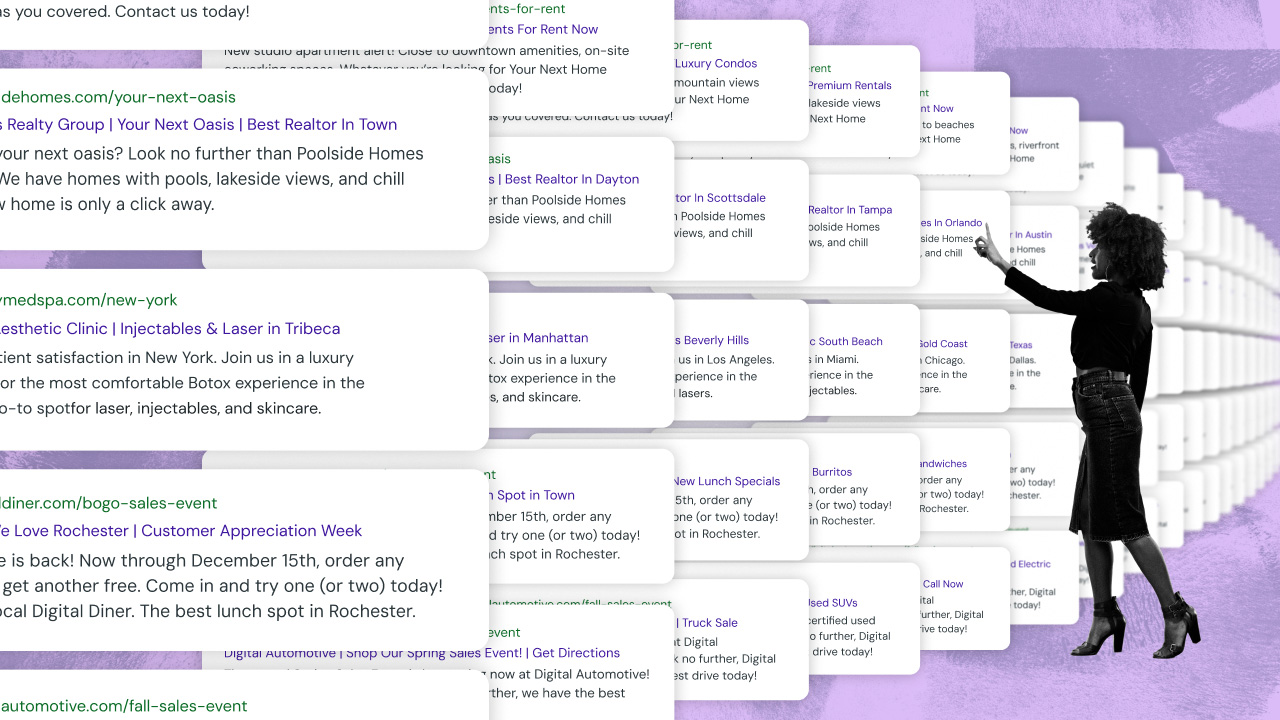
- Tap into localized advertising efforts at scale: RPA can automate your "national-to-local" strategy. For example, Fluency Blueprints can take a single asset and generate hundreds of localized versions tied to specific Facebook Business Pages and local addresses. RPA handles the manual geo-fencing, brand consistency, and page-tagging for every location while your team handles the localization strategy.
- Test strategic updates at scale: Instead of manual Facebook Ads A/B tests, RPA can deploy "challenger" ad sets across your entire account structure. For instance, your teams can test a new Instant Experience format against standard video ads. Once a winner is decided, teams can easily assign automated workflows to move spend to the winning format.
Within Fluency’s DAOS, RPA also streamlines technical Meta-specific workflows, including:
- Creative fatigue mitigation: If CTR or engagement drops below a specific threshold, RPA can automatically swap in fresh creative from your library to stop CPMs from rising.
- Dynamic catalog sync: RPA makes it possible to keep your Meta Dynamic Product Ads (DPA) perfectly aligned with inventory levels. Let’s say a SKU goes out of stock on your site. Automated workflows update the Facebook Catalog in real-time, halting spend on unavailable items.
- Audience exclusion hygiene: RPA can also automatically refresh your Custom Audiences. Automation rules can move recent purchasers to "Exclude" audience lists across all active Meta Ads campaigns. This keeps prospecting budgets focused on new lead generation rather than blowing them on redundant retargeting.
RPA Facebook automation isn't just about time saved. It's about establishing consistency and responsiveness in your Meta Ads campaigns, which is nearly impossible to achieve with manual workflows.
RPA for advertising’s ultimate impact on long-term ROI
We’ve already covered how RPA brings precision to advertising budget management. Now, imagine what your company’s margins could be if optimized budgets are never under- or overspent: it can mean tens or even hundreds of thousands of dollars in commission percentages per year.
RPA for advertising also drives customer satisfaction and retention. Happy customers mean more referrals and lasting, collaborative, and mutually beneficial relationships.
Finally, there’s the gift of time. Digital advertising is a game of creativity; any increase in time spent on the actual creative is both welcome and valuable. RPA gives advertisers more time to focus on their creative and strategic strengths. This has lasting results on business performance for both agencies and their clients alike.
Key takeaways
- RPA isn't hype: it handles the tedious parts of digital ad management so your team can actually do their jobs.
- The RPA market is growing because it delivers results.
- Used within a comprehensive system like Fluency, RPA can work across platforms and ad channels like Google Ads and Meta Ads. That means less operational friction and a higher automation ROI.
- Enterprise advertising operations benefit the most from using automation. Manual oversight at that scale is unrealistic.
How to choose the right RPA partner for advertising
RPA often gets lumped in with standard platform automation. That’s a mistake. Most tools automate within their own rules, but RPA should be built to follow yours.
Think about how your AdOps team runs today. Are you comfortable adapting your strategy to match a platform’s built-in logic? Or do you want software that runs on your bidding models, naming conventions, margin targets, and operational data at scale?
If your team values maintaining strategic control and flexibility, RPA for advertising is a great solution. RPA isn’t designed to replace your strategy (or the human teams running it). Instead, think of RPA as the infinitely scalable engine that can execute your strategic plays consistently and efficiently.
Ultimately, the right RPA partner should provide your team with a unified operational layer that bridges the gap between high-level vision and platform-specific execution across multiple ad platforms. By ensuring your unique business logic remains the primary driver of your results, you can finally scale your advertising operations without being capped by the limits of human bandwidth.
Related Posts
Agentic Programmatic Advertising for Multi-DSP Execution and Governance