Build vs. Buy for Agentic Advertising: What You Need to Know
Published on
August 24, 2026
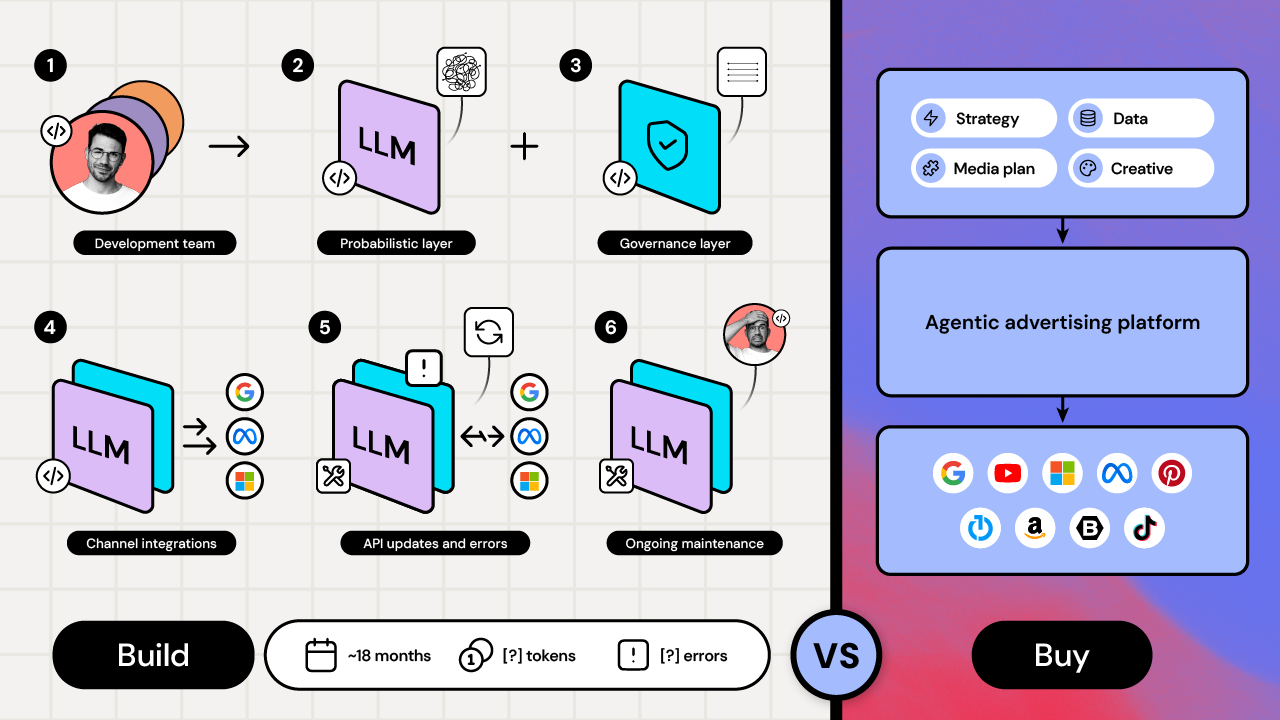

Agency media buyers and brand media teams evaluating agentic advertising infrastructure face a decision with long-term operational consequences. The build path requires at least 18 months of dedicated engineering, ongoing API maintenance, and custom governance architecture. The adoption path compresses time-to-production, but only if you can identify what separates a production-grade platform from a well-marketed API wrapper.
---
Should you build your own agentic advertising infrastructure internally, or adopt a platform that already has it?
Either path requires getting three things right: an architectural split between AI reasoning and live campaign execution, the integration of live business data, and governance enforced at the infrastructure level. Without these elements, your agentic advertising system will break as you scale or become ungovernable.
This means your build-vs.-buy decision is really a question of who constructs and maintains these three core components of agentic advertising, both as you’re getting started and into the future. This article walks through what each path actually demands, how to evaluate agentic advertising systems, and how to tell a production-grade platform from an API wrapper before you sign anything.
What it takes to build an agentic advertising system in-house
Building an agentic advertising system internally can be the right path when you have a proprietary data asset no vendor can ingest natively, a compliance regime specific enough that governance rules must be authored against internal policy documents rather than configured, or a business model where owning the execution logic end to end is the point. But you should also weigh the resource costs: at least 18 months of building the solution, continuous ad platform API maintenance, LLM token costs, and a higher likelihood of errors and breaks.
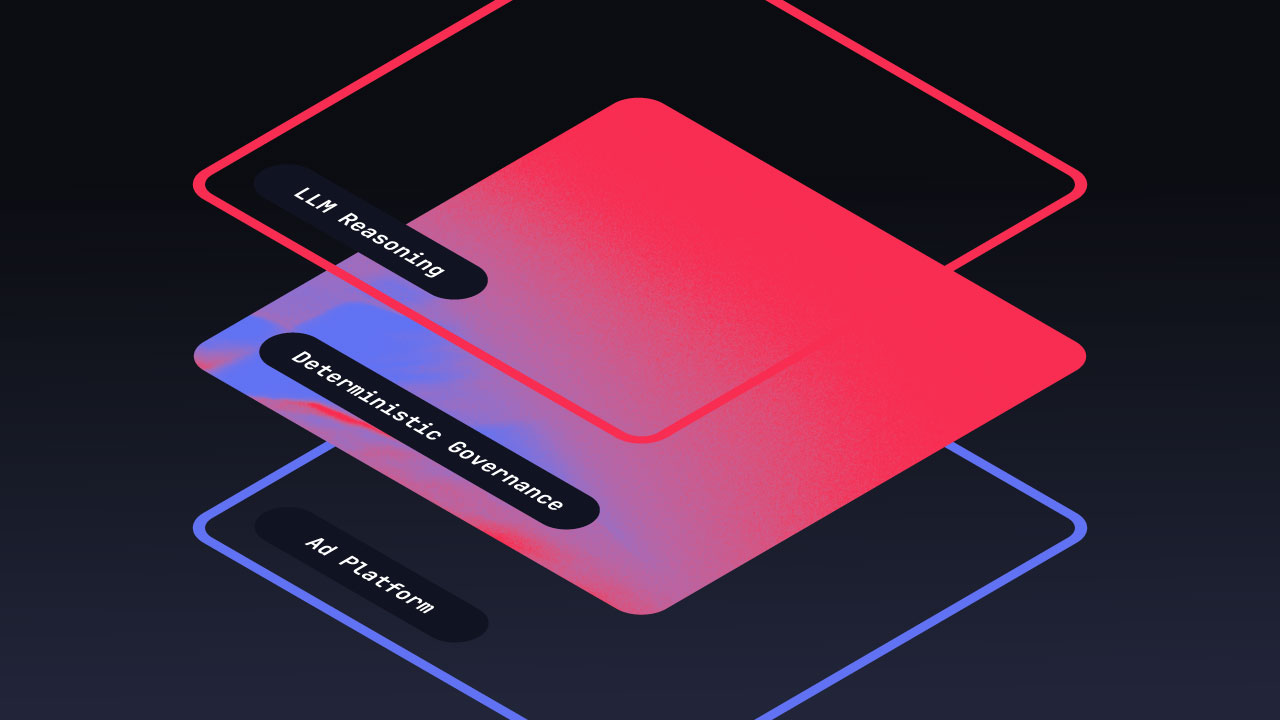
Choosing to build your own agentic advertising system is a continuous uphill battle for most organizations. A “build” approach places high demand on your engineering team. For starters, they need to develop the full two-layer architecture stack (a probabilistic AI interface and a deterministic execution layer) from scratch.
A highly competent engineering team should expect to dedicate 18 months to this phase alone, assuming they have no competing priorities. The costs that compound after that are where most initial projections fall short.
Next, you need to make sure the system includes platform-specific integrations for every channel you operate on. This is where ongoing maintenance plays a big role. Ad publisher APIs change frequently. The Google Ads API updates monthly. Meta’s Marketing API versions rotate every four months (and Meta suggests updating Marketing API or SDK versions within 90 days, before they depreciate). If you choose to build in-house, you’re committing to permanent API maintenance.
You'll also need to keep pace with evolving AI protocol standards. Standard protocols exist for general-purpose AI tools, but advertising-specific protocols like AdCP and AAMP are what allow agents to understand the strict demands of digital advertising. They're how agents know the difference between a macro campaign parameter and an isolated audience targeting token, for example. Staying current as AI standards evolve is an ongoing commitment for your team, not a one-time integration.
It’s also critical to include a hard-coded governance infrastructure to fire below the agent. Encoding governance into the system ensures rules are followed every time, not just the “sometimes” you get when writing requirements into individual prompts. For example, if you’re only tasking an LLM with making these decisions, it will always take the shortest path available to do something like “improve underperforming ads,” which may include budget moves that don’t align with client goals or monthly limits.
None of these engineering asks are one-time projects. They are permanent, ongoing commitments, requiring detailed work and attention from your engineers.
There are other costs to consider, such as the price of LLM token usage. Demo-scale LLM usage estimates don't reflect production-scale volumes. LLM costs compound quickly when you’re managing thousands of campaigns, with millions of daily micro-decisions, via agents.
Plus, if you’ve not built the system correctly or encoded it with platform-native intelligence, you’ll likely generate errors at a higher, faster rate than existing enterprise-scale solutions. These errors can result in budget blowouts, learning phase resets, and even compliance violations. These costs are hard to forecast and rarely appear in initial build projections.
What a production-grade agentic advertising platform provides
For most advertising organizations, adopting a proven agentic advertising system is the faster, more economical path to a working agentic operation. A production-grade platform provides you with: a lock-tight architecture that separates AI reasoning from deterministic execution; platform-native intelligence encoded for core ad channels; a data integration layer that connects live business signals to campaign execution; governance enforced in the infrastructure; and a maintenance commitment moving with publisher API changes and evolving protocol standards (e.g., AdCP and AAMP).
When shopping for the right agentic advertising solution, focus on vetting vendors that have proven safe, secure agentic workflows at production scale. You’ll only reap the benefits of adopting an agentic system if the platform has actually built the foundational architecture required to work at scale.
Why is this so important? Many current or emerging solutions claim to be production-grade tools but are effectively API wrappers with AI interfaces layered on top. The adoption path only delivers its advantages if the platform you select has done the work to build the right solution from the ground up.
You can also ask a vendor for specific examples of platform-specific logic to check that hard-coded platform-native depth is encoded in the execution layer. For example, you can ask:
- How does the system handle a Meta budget change mid-flight?
- What happens when a Google Ads bid strategy adjustment would invalidate campaign history?
If you get vague answers, the tool is likely just an API wrapper. It won’t serve you in the long run, as your agency and agentic operations grow.
Lastly, the right software vendor takes the stress and worry of ongoing AI protocol and API maintenance off your plate. Put this work into the hands of engineering teams who are solely dedicated to keeping the system running properly, all the time, at scale. Best of all, it means your team stays focused on building and running the right advertising strategies, not updating API connections.
What separates a production-grade agentic platform from an API wrapper
Distinguishing between production-grade agentic advertising systems and tools that are, effectively, API wrappers with AI interfaces layered on top is deceptively difficult. This is especially true because many vendors use identical terminology to describe fundamentally different systems.
Here are six questions to ask agentic software vendors to determine if their solutions are truly built for secure, reliable scale.
- Where does governance live? A production-grade platform enforces governance at the infrastructure level. It must be hard-coded into the system before any platform call is made. An AI wrapper is more likely to rely on prompt-based guardrails. An LLM can reinterpret, ignore, or route around those.
- How does your platform handle publisher-specific advertising rules? A production-grade platform has genuine operational logic encoded for each channel it manages. Most importantly, the system should account for each publisher’s specific bidding logic, learning phase sensitivities, and campaign management rules. Vague answers, or answers describing the platform making a "smart decision,” lean more toward the solution being an API wrapper that lacks the necessary nuance of multichannel advertising management.
- Do you adhere to open industry AI standards or use proprietary AI protocols? Actively aligning with emerging frameworks (like the AdCP and AAMP protocols) makes it more likely that an agentic solution won’t cause future tech stack fragmentation. On the other hand, proprietary communication standards can create vendor lock-in and interoperability challenges over time.
- Can I fully audit all agent-made decisions? You should be able to access a complete audit trail for every agent action. That means every pacing, bidding, and optimization decision. Full auditability requires that the vendor has properly separated probabilistic AI tasks from deterministic execution work. If a system can't show you exactly what it did and why, it isn't governable at scale.
- How can my team inspect, override, and audit agent decisions? Make sure the solution values and empowers your team’s knowledge instead of simply overriding it. Your team should be able to inspect every agent action, access a full audit trail, and override decisions. If the tool is actually just an AI wrapper, you’ll likely discover that agent actions are visible but not traceable. That’s not governable at scale.
- How much do you currently manage, in terms of spend or campaign volume? A viable vendor will be able to answer directly when asked about total managed ad spend, simultaneous campaign count, or uptime record under production load. Demo-grade systems often perform well in controlled settings, but they tend to struggle when managing thousands of campaigns across live publisher APIs simultaneously.
How to make the “build vs. buy” decision for your agentic advertising program
For most advertising organizations, adoption is the faster and more economical path to a working agentic operation. The build path makes sense when your advertising operation is itself a competitive asset (a proprietary data set, a compliance regime no vendor can configure to spec, or a business model where owning the execution logic is the point). Outside these conditions, the engineering investment, maintenance overhead, and time-to-production costs are difficult to justify against adoption.
Don’t underestimate the full cost comparison. Building in-house requires more than development hours. You need to account for permanent API maintenance overhead across every platform you operate on. There’s also the matter of LLM operating costs at production volume, which will increase exponentially as your agentic operations do. You’ll want to cushion your budget for hard-to-forecast error costs of a system not encoded with platform-native intelligence: budget blowouts, learning phase resets, and compliance violations that rarely appear in initial projections.
Compare these operational, financial, and (let’s be honest) emotional costs against a production-grade platform's managed spend pricing model and the labor efficiency you gain. For most organizations evaluating “build vs. buy” for agency advertising solutions, the ongoing resource commitment an in-house build requires doesn't show up in year-one projections but dominates year two and beyond.
Curious how to lay the right foundation for agentic advertising, even if you’re still weighing your technology options? Start with these four things:
- Audit where your team's hours go. Build a simple time allocation map: what percentage of AdOps hours are execution tasks an agent could handle? This data anchors your business case and your change management conversation.
- Run the build-vs-adopt decision through the full cost model. Include maintenance overhead, LLM operational costs at scale, and error cost — not just initial development. Compare against the adoption path economics, including labor efficiency gains.
- Map your current tech stack against the two-layer architecture. Where is your deterministic execution layer today? Where are agents or automations operating without one? The gaps are your highest-risk surfaces.
- Identify one workflow to pilot. Choose a high-volume, high-repetition process with low tolerance for errors—budget pacing, campaign QA, and localized creative deployment are common starting points. A constrained pilot generates real organizational learning faster than a broad rollout.
Remember, investing in the right strategy now is key to laying out the path for compounding efficiency gains once the tech is in place, both for your current AdOps and as agentic workflows play an increasingly larger role in our industry.
Frequently asked questions
How do I decide whether to build or buy agentic advertising capabilities?
The build path makes sense if you have dedicated engineering resources or competitive reasons to own the system entirely. For most advertising organizations, adoption is the faster, more economical path. When you consider the build timeline, ongoing API maintenance overhead, LLM costs at production volume, and error costs from a system without platform-native intelligence, the “buy” path is more economical and scalable.
What are the risks of using AI in digital advertising?
The primary risks come from deploying probabilistic AI (e.g., LLMs, or large language models) without a deterministic execution layer buffering AI decisions from live campaigns. LLMs don't produce identical outputs from identical inputs, making them unreliable for tasks like cross-channel budget reallocations, bid adjustments, and strict compliance enforcement. Using a hard-coded deterministic execution layer to govern AI recommendations before they reach a publisher API eliminates these risks.
How long does it take to build an agentic advertising system in-house?
An in-house system capable of handling enterprise-scale governance, multiple platform APIs, and precise execution will take at least 18 months. This assumes you have a fully dedicated engineering team with no competing priorities. After launch, the system requires permanent maintenance: updating ad publisher APIs, managing advertising-specific AI protocols, and integrating new publisher releases.
How can I use AI agents to execute advertising campaigns without them going rogue?
Governance must live in your infrastructure, not in an AI prompt. You need a deterministic execution layer, hard-coded into your agentic infrastructure, to evaluate every AI recommendation against defined business rules before any action reaches a publisher API. This layer is critical for keeping agents within safe operational boundaries. For example, if an AI suggests a change that contradicts a geo-level exclusion set by your client, the deterministic layer intercepts it, then either recalibrates within defined thresholds or routes it to a human for review.
What should I look for when evaluating an agentic advertising platform?
Ask six questions: Does governance live in the infrastructure or in a prompt? Does the platform have a genuine deterministic execution layer? Does it align with open AI protocol standards like AdCP and AAMP? Can it demonstrate platform-native intelligence with specific examples, not general claims? Does it offer full human-in-the-loop controls and a complete audit trail? And can it provide evidence of enterprise-scale production operations: total managed spend, campaign count, and uptime?
Related Posts
How is Agentic Automation Used in Digital Advertising?