
Agentic advertising automation delivers the clearest returns across four workflow areas: performance reporting, campaign launches, budget pacing, and creative management and variation. For agencies managing hundreds of client accounts and brands running multi-location programs, these eight use cases illustrate where autonomous execution saves you time, eliminates errors, and helps you grow without hiring more people.
---
The agentic advertising workflows that will bring you the most value share three characteristics: they are high-volume, highly repeatable, and disproportionately time-consuming relative to the strategic judgment they require.
Simply put: when a task’s execution requires accuracy rather than original or strategic thinking, it is a prime candidate for agentic automation.
The eight use cases in this article show where AI agents can make the biggest impact across four advertising operations workflows: performance reporting, campaign launches, budget management, and creative trafficking.
Together, these use cases represent the bulk of repetitive AdOps work in most agency and brand operations and, as a result, the clearest opportunity to put your talented experts back on higher-value work.
How agentic workflows automate campaign performance reporting and anomaly detection
Agentic reporting workflows compile cross-channel performance data on a defined schedule, generate AI-narrated summaries with context-specific commentary, and produce client-ready reports automatically and at scale. All your teams need to do is review the work and add their own perspectives when necessary.
Reporting agents can also monitor performance signals continuously across your entire portfolio. These agents surface anomalies immediately and generate contextual explanations for each one. They can tell you what changed, why it matters, and what your human team should consider when deciding what to do.
These two use cases exemplify the value of agentic reporting workflows: one on automated performance report generation and distribution, and the other on real-time anomaly detection.
How Cox Automotive automated performance reporting for thousands of dealerships
Cox Automotive manages advertising programs for thousands of automotive dealership clients. They use Fluency's agentic reporting workflows and Muse, Fluency's integrated AI, to automatically build and distribute monthly client performance reports at scale. Across hundreds of clients, Cox Automotive has reclaimed 83 working days (roughly 650 hours) of reporting labor every month.
The agentic workflow
Each report is generated from live campaign data, automatically incorporates each dealer's brand guidelines and most critical KPIs, and is distributed to dealerships without manual work from the team.
Why it works
Before using Fluency, each monthly performance report took 40 minutes to build and days of work. Using agentic reporting workflows, each report only takes 15 minutes to build. Every dealership client receives a fully standardized report at the same time—complete with AI analyses, real-world performance outputs, and client-specific recommendations. It’s a win-win: Cox Automotive’s clients get faster, more sophisticated analysis, and strategists get their time back.
How agentic systems detect and flag performance anomalies across a large ad portfolio?
Agentic campaign monitoring flags CPM spikes, pacing irregularities, and conversion drops across a large portfolio within hours or minutes. Each alert includes AI-generated explanations of what changed, why it matters, and what teams should consider doing. Without these multichannel alerts, anomalies often go unflagged for days. By then, the damage is already done.
The agentic workflow
The system monitors real-time, multichannel performance signals across the entire portfolio, surfacing any anomalies as they arise. These alerts include AI-generated contextual explanations about what changed, why it matters, and what the team should consider doing. Alerts are prioritized by financial impact, keeping teams pointed toward the most critical situations.
Why it works
Issues that previously went undetected for days are flagged within hours or minutes. Human attention is directed to the accounts and decisions that need it most. The system does the monitoring; the strategist does the judgment.
How agencies automate campaign builds and launches across hundreds of clients
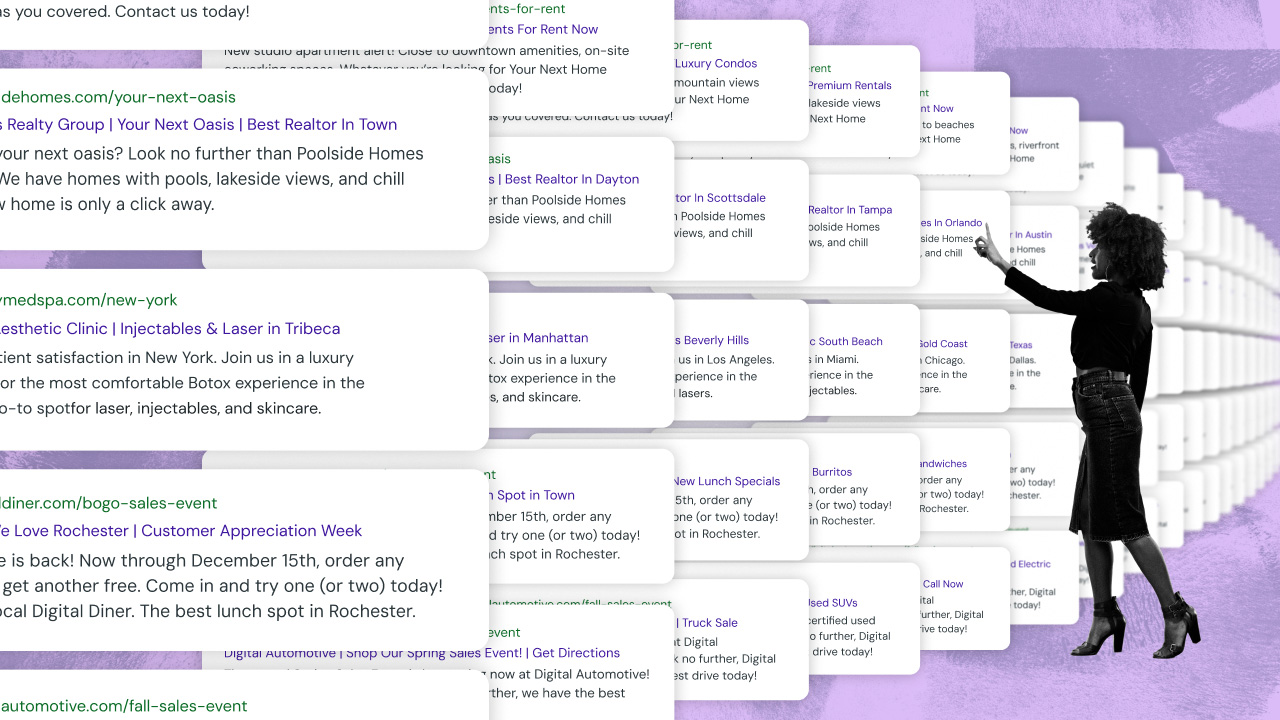
Agencies automate campaign launches by encoding campaign structure, budget rules, creative logic, and compliance guardrails into reusable templates that an agentic system can execute at any volume. The system executes the campaign build process whenever it’s triggered by the right business event—for example, when a new location is added, a client is onboarded, or a competitive signal is detected. This keeps strategic work in the hands of human teams at the template level. All instance-level execution tasks are passed off to agents.
Here are two use cases demonstrating how agentic campaign builds and launches transfer the execution burden from the team to the system while keeping human strategy and approval at the template and rules level: one on templated launches at scale and one on signal-driven campaign activation.
How Storage Rentals of America launches new location campaigns within 24 to 48 hours
Storage Rentals of America (SROA) manages paid media for a 700+ location self-storage portfolio with a lean two-person in-house team. Using Fluency’s agentic workflows, SROA can bring newly acquired locations live across Search, Social, and Display within 24 to 48 hours without manual work. Before adopting agentic campaign templates, manual bandwidth restricted the team to operating a single advertising channel.
The agentic workflow
When SROA acquires a new location, the location's data is ingested into Fluency. The system automatically generates and deploys location-specific campaigns built to SROA's brand standards and platform requirements across every active channel simultaneously.
Why it works
A two-person team managing SROA’s extensive portfolio was operationally capped at a single channel. Agentic campaign templates removed that ceiling. The team now governs strategy and guardrails at the template level while the system handles every instance-level build. "I was in an investment meeting where someone asked, 'Do you think you can do this with just the team you have today?' I knew I could because Fluency gives us the automation we need to scale," said Melissa Cartagena, CMO at Storage Rentals of America.
How do agentic systems activate campaigns automatically from live data signals?
Agentic advertising systems convert competitive signals directly into live campaigns. Agents can launch conquest sequences within hours of a trigger event, with no manual intervention required.
Example: An automotive dealer network has historically missed or responded too slowly to competing dealership closures. Agentic workflows close the gap between real-time data signals and live campaign execution.
The agentic workflow
The system monitors a defined data trigger (e.g., a competitor closure signal) and automatically initiates a campaign sequence that's pre-built by human strategists. The agent adjusts budgets, targeting, and creative to capitalize on the opportunity while staying within the team's defined strategic and budgeting guardrails.
Why it works
Speed-to-market on competitive opportunities is achieved within hours, not days. Humans control and monitor the strategic logic in the team's runbook, relying on the agentic system to execute data-driven ad campaigns at scale.
How agentic workflows automate budget pacing and reallocation across accounts
Agentic budget management systems monitor multichannel pacing, in real time, across all accounts. These agentic systems can automatically adjust daily budgets to stay within defined parameters without requiring manual intervention for routine budgeting decisions. Human teams stay in the loop and only put out fires when anomalies fall outside predefined thresholds.
For agencies managing hundreds of client accounts across Google, Meta, and programmatic channels, agentic budgeting workflows go from being one of the highest time-cost workflows in AdOps (12.75 hours per strategist each month on budgeting tasks alone, according to our 2025 AdOps Benchmark report) into a background system operation. Best of all, you eliminate overspend errors and underspend risk: with agents monitoring every campaign and channel continuously, your spend is protected around the clock, even when your team signs off.
Here are two agentic budget management use cases: one on automated cross-platform pacing and one on business-signal-driven budget reallocation
How Location3 doubled campaign capacity by automating budget pacing
Location3 is a digital marketing agency specializing in complex franchise systems and brands, managing thousands of localized campaigns across Google, Meta, and programmatic channels. By integrating Fluency's agentic budget management solutions, Location3 eliminated overspend and doubled each strategist's campaign capacity from 1,000 to 2,000 campaigns. Prior to using budgeting agents, Location3’s manual budget entry workflows created excessive overspend errors that directly threatened agency margins. Additionally, rigid monthly cutoff dates bottlenecked campaign launches.
The agentic workflow
Fluency's rules-based budget management system monitors pacing in real time across all franchise client accounts and automatically adjusts daily budgets to stay within client-defined parameters. Human review is triggered only when anomalies fall outside defined thresholds. Hard monthly submission cutoffs are replaced by fluid, real-time launches that happen when one of Location3’s clients requires them.
Why it works
"Human capital is our number one cost,” said Andrew Beckman, Founder at Location3 “An advisor used to manage about 1,000 campaigns, and performance would dip. With Fluency, they can manage 2,000 campaigns. That's where agentic automation has helped our profitability." Additionally, overspend errors have been eliminated with agents monitoring every campaign and channel 24/7. For Location3, removing manual pacing from thousands of franchise campaigns protected margins while fundamentally improving strategist capacity.
How Storage Rentals of America automates real-time budget decisions across 700+ locations
Storage Rentals of America (SROA) manages paid media across 700+ self-storage locations with a lean in-house team. Using Fluency's agentic budget management, SROA connects live business signals—occupancy rates, move-ins, and unit pricing—directly into its advertising execution layer. Agents automatically reallocate daily ad spend across locations as local conditions shift in real time. This helped SROA achieve a 91% average improvement in CTR across search campaigns (from May–July 2026, compared to the prior 90-day period).
The agentic workflow
SROA’s live occupancy data feeds directly into Fluency. When occupancy at any location crosses a defined threshold, budgeting agents automatically reallocate spend according to rules designed by the SROA strategy team. Agents carry out the right reallocations so the team doesn’t need to make manual adjustments every time occupancy data changes.
Why it works
Managing budget decisions across 700+ locations in response to live business data was impossible at SROA’s team size without agentic automation. Now, agentic budget management makes it possible to turn real-time business context into real-time advertising decisions. The SROA team controls the strategic rules and the system handles execution across their full portfolio.
How agents push creative updates across thousands of localized campaigns simultaneously
Agentic creative management gives you centralized variable control by storing all offers, disclosures, and other dynamic creative elements as single, tagged variables within the system. When a variable changes, the update propagates across all campaigns automatically. Agents can rewrite headlines on live campaigns, update disclosures, and even adjust platform-specific ad formats. One update at the variable level replaces what would otherwise require touching thousands of campaigns individually.
If run through a true agentic advertising operating system, governance is enforced at the infrastructure level. That means agents execute error-free creative changes by using the brand compliance and governance guardrails your team has encoded within the infrastructure.
Let’s look at two agentic creative refresh use cases: one on simultaneous offer updates for localized campaigns and one on AI-generated variant testing performed within defined brand parameters.
How do agents push offer updates across thousands of localized campaigns simultaneously?
Using agentic workflows, a single variable update on a national campaign can get pushed to thousands of campaigns simultaneously. Agents can rewrite headlines, update disclosures, and adjust platform-specific ad formats automatically, in minutes, with compliance enforced throughout.
Example: An automotive OEM wants to propagate a financing offer update to 3,000 dealer campaigns across Search and Social campaigns. This update used to take a team multiple days to implement. Now, it takes place nearly instantaneously.
The agentic workflow
The offer is stored as a single variable in the agentic advertising system. When the offer data tag changes, agentic workflows push the update across all 3,000 campaigns instantly. This includes modifying headlines, updating disclosures, and tweaking ad formats to work for each platform. A deterministic governance layer ensures every update adheres to the OEM's pre-set brand and compliance guardrails.
Why it works
What previously required a team working across multiple days becomes a single update that autonomously executes in minutes. Brand consistency and compliance are maintained automatically, encoded in the strategic requirements, with human review only needed at the offer level rather than the campaign level.
How do agents generate and traffic ad creative variants at scale?
Agentic creative workflows scale systematic ad testing across an entire portfolio: agents generate brand-compliant copy variants and traffic them automatically.
Example: A performance marketing team wants broader testing coverage but lacks the human bandwidth to generate and traffic multiple creative variants per campaign.
The agentic workflow
AI generates ad copy variants within defined brand voice parameters. Deterministic agents handle trafficking, budget allocation across variants, and reporting structure to present winning variations. Ad strategists review and approve the creative strategy and guardrails, with the agentic system handling all copy generation and execution.
Why it works
Creative testing expands from a few campaigns to the entire portfolio without requiring more staff members or working hours. The agentic governance layer ensures all variants comply with strict brand standards before they run.
Frequently asked questions about agentic advertising use cases
What are the most common agentic advertising use cases?
The most common agentic advertising use cases fall across four workflow categories: performance reporting and anomaly detection; campaign builds and launches; multichannel budget management and pacing; and creative and ad variation management. These workflows are all high-volume, high-repetition tasks that take more time to manually execute than the strategic judgment required to pull them off. This is what makes them well-suited to autonomous execution at scale.
How do agencies automate campaign launches across hundreds of clients?
Agencies automate hundreds of simultaneous campaign launches by encoding campaign structure, budget rules, creative logic, and compliance guardrails into templates that an agentic system executes en masse. When a new client, location, or trigger event occurs, agents generate and deploy the corresponding campaigns automatically. A deterministic engine ensures the correct parameters are applied. Humans don’t have to build anything: they only need to set and review the template and rules, not every individual campaign.
How do I scale paid search campaigns across 500+ locations?
To scale paid search campaigns across 500 or more locations, you need a way to convert campaign structure, targeting parameters, and creative into machine-readable templated variables. This enables an agentic advertising system to ingest location data and generate compliant, location-specific campaigns automatically (including geo-targeting, localized headlines, and budget allocation limits) at a speed and consistency no manual process can match. Human teams govern the campaign template logic, and agents execute location-specific campaigns.
How do I reduce manual work in ad operations without losing strategic control?
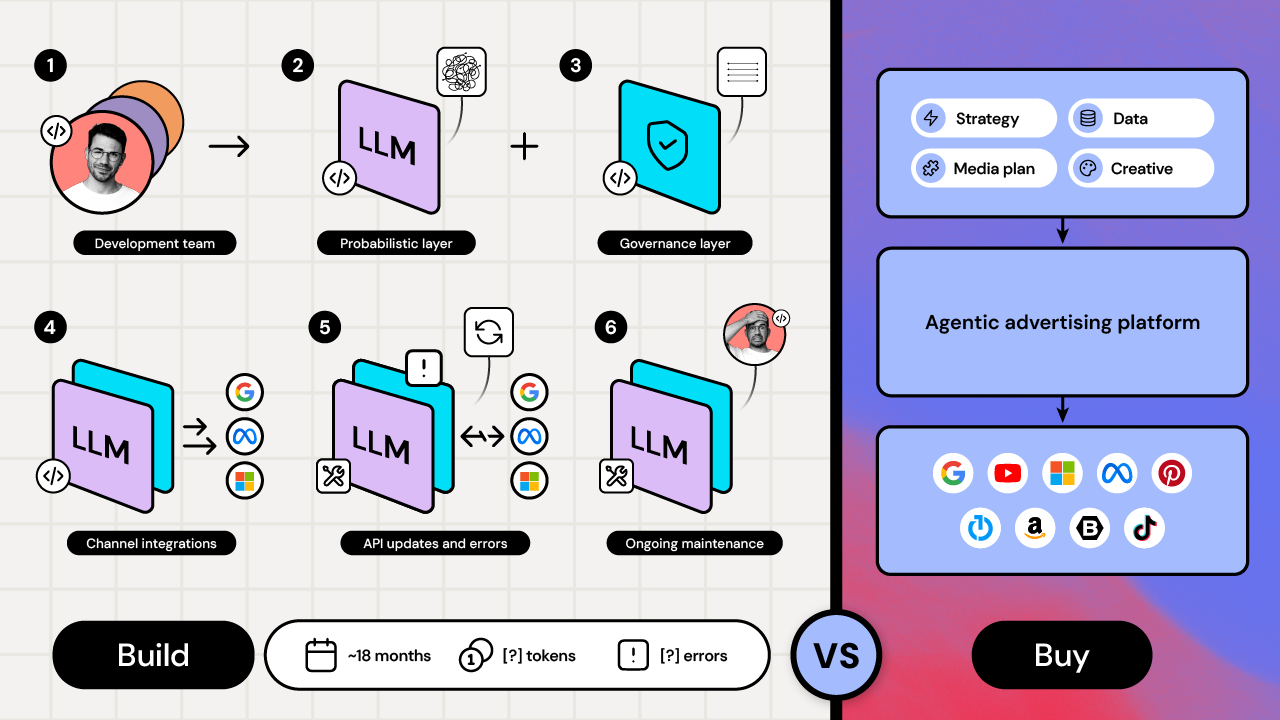
Reducing manual AdOps work without relinquishing strategic control requires routing live campaign task execution through a rules-based deterministic system instead of relying strictly on open-ended AI. LLMs can drift off strategic requirements, and even the best prompt can be interpreted inconsistently. Deterministic automation is the only way to execute exactly what your AdOps team has encoded for specific campaigns, including budget caps, compliance rules, naming conventions, and platform-specific constraints. Human oversight is maintained at the strategy and guardrail level, and every agent action is auditable.
How do I ensure brand safety and governance when AI agents are running campaigns?
You must enforce brand safety and governance in an agentic advertising operation at the infrastructure level, not in a detailed prompt fed to an LLM. By encoding hard-coded campaign rules (like brand compliance requirements, approved creative variables, platform-specific constraints, and budget authorities) into a deterministic execution layer, every AI-recommended adjustment is checked before reaching live campaigns. Setting governance at this layer constrains the system, is not a suggestion agents can override; it is the constraint the system operates within.
Where should ad teams start with agentic automation?
The best place to assign advertising agents is in a workflow that is high-volume, highly repetitive, and governed by well-defined rules. Budget pacing, campaign QA, and localized creative deployment are common first pilots. These advertising workflows have clear decision logic, measurable outcomes, and a limited tolerance for errors. This makes them well-suited to constrained use cases that generate real organizational learning without exposing your full portfolio to unnecessary risk.
Related Posts

How is Agentic Automation Used in Digital Advertising?