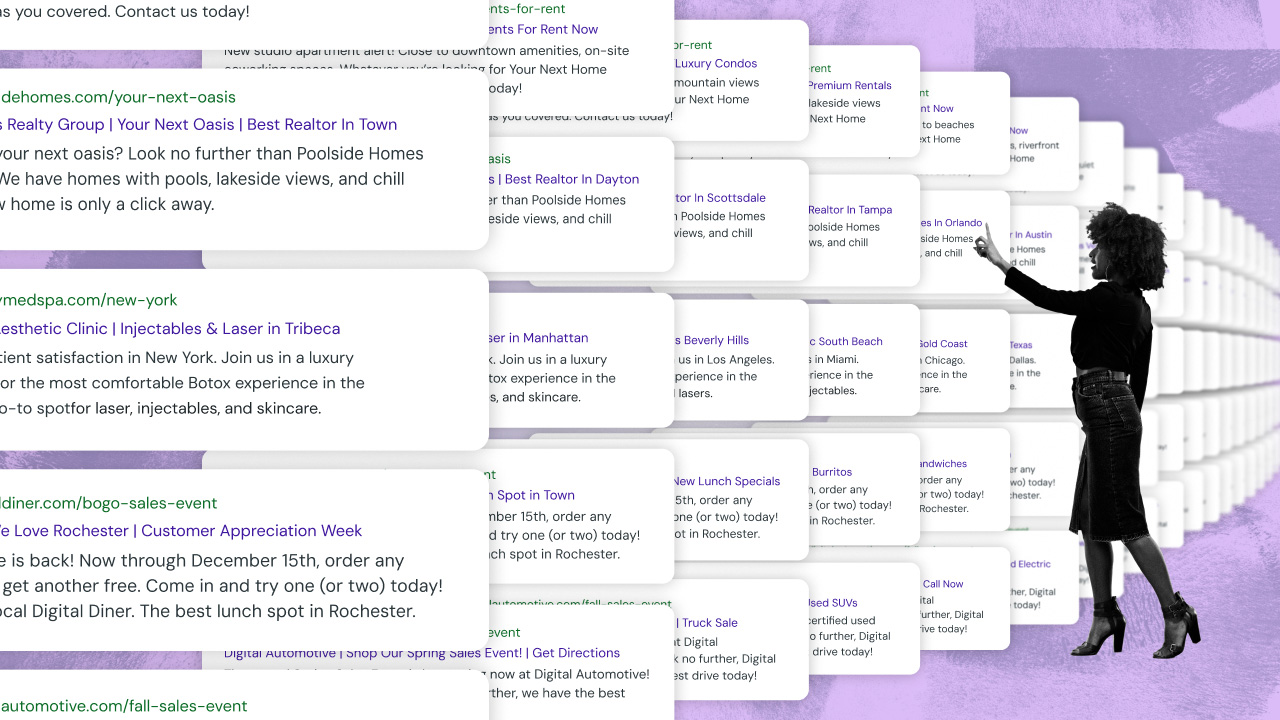
How to Scale Hyper-Local Campaigns Without Brand Risk: Your AI and Automation Playbook
Published on
April 16, 2026
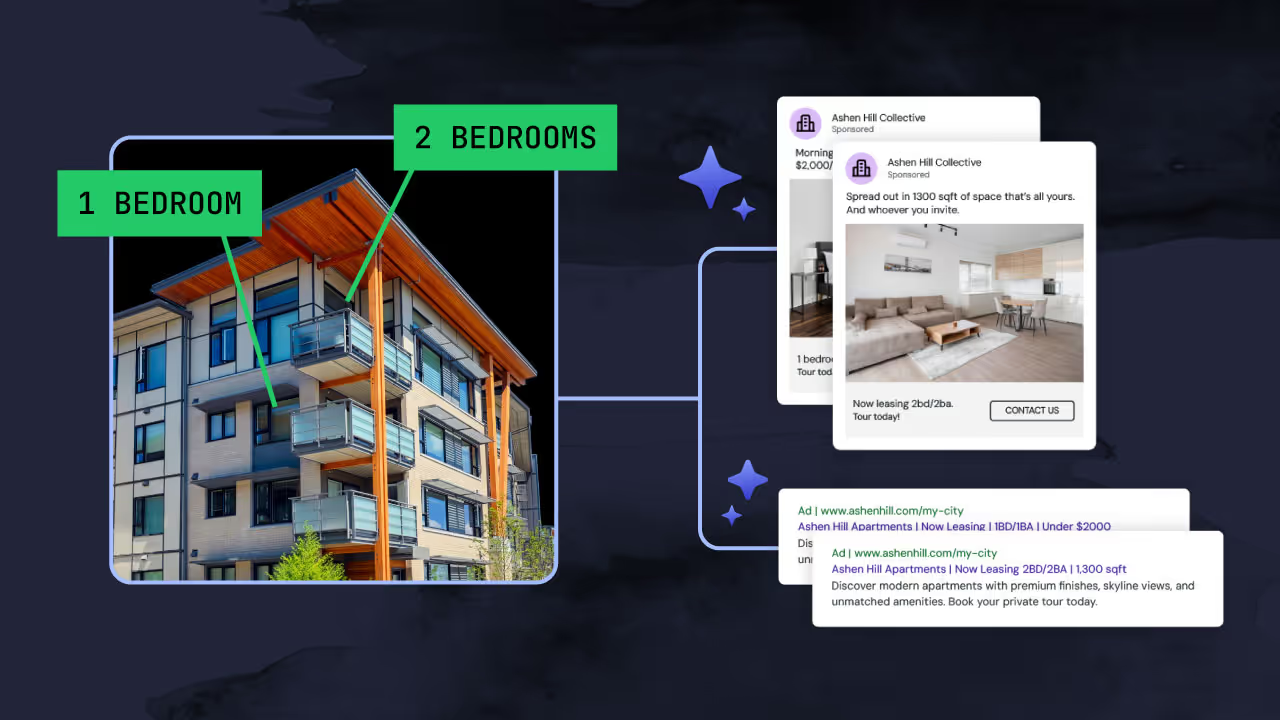

Scaling hyper-local ad campaigns for franchise brands means managing thousands of location-specific ad sets while ensuring every piece of copy, creative, and offer clears brand compliance and regulatory requirements. Manual localization puts agencies at constant risk of transposing the wrong copy, image, or offer into the wrong campaign - jeopardizing client trust and wasting spend. Learn how AdOps teams use a Digital Advertising Operating System (DAOS) like Fluency to generate compliant, localized ad copy directly from live data sources and hard-code compliance rules into every automated workflow before a single ad publishes.
---
Anyone running ad campaigns for franchise brands or multi-location accounts has felt the mental and financial cost of executing localized campaigns at scale. You are constantly trying to adhere to global brand standards (or regulatory requirements) while localizing ad copy or creative with specific offers, prices, or messages.
These complex challenges are the same whether you are localizing ad campaigns for specific regions or working with individual franchise owners who set their own promotions. And if you get these localization efforts wrong? You jeopardize client trust, dent your margin, and waste spend.
Luckily, you don’t have to tackle these challenges alone. This article walks you through how AdOps teams can to use AI and automation to scale hyper-local ad campaigns while adhering to strict brand guidelines or compliance regulations.
How to ensure ad compliance at scale with structural, systematic efficiency
Winning a large-scale client with multiple locations is a huge win and opportunity for any agency. You want to get it right. The trade off of winning a franchise account, though, is the immense workload. Building hyper-relevant ad sets, QA’ing multichannel campaigns for the right location-and-promo pairs, making updates when a franchise owner wants to change something…it all takes so much time.
To bridge the gap between manual human error and automated efficiency, agencies are increasingly centralizing their advertising execution architecture. This shift requires a foundational tech layer to run your entire advertising operations.
Solutions like a Digital Advertising Operating System (DAOS) connect your data sources (like CRM or inventory feeds), your people, your processes, and your advertising publishers into one unified place. This drastically simplifies the work required to build, launch, and manage localized ads at infinite scale.
At the core of this operational functionality is the ability to tag specific components of your data sources: cities, phone numbers, addresses, specials, headlines, store front photos, product feeds…essentially, any data source you want to use for targeting or ad creation. Once tagged, you can simply insert the correctly tagged elements into campaign templates and automated workflows build the correct number or ads in the right format.
Let’s take a look at how running your AdOps this way enables you to scale hyper-local campaigns using AI and automation while adhering to strict brand guidelines or compliance regulations.
Automation use case: how to build brand-safe, locally-targeted ad campaigns at scale
Automation is what makes data-powered localized campaigns viable at scale without the risk of breaking brand standards or compliance rules.
Manually copy-pasting elements from a spreadsheet into individual ad platforms for one-off ad builds puts you at risk of transposing the wrong copy, image, or offer into the wrong ad. By tagging your data sources and syncing them with a DAOS, you can use automation to insert the correctly-tagged elements into ad copy automatically.
A DAOS like Fluency syncs data sources directly to platforms (including images from Google Drive or a website) so the right creative always routes to the right campaign, regardless of how many nuanced parameters are involved.
Our TikTok partnership for automotive advertisers is a great example of using automated workflows for compliance adherence. Say you want to serve your best-performing SUV creative to local shoppers. However, maybe the OEM co-op requirements mandate a legal disclaimer overlay on any "Sales Event" offer and prohibit the offer applying to any used SUV in your inventory.
Managing this TikTok campaign through Fluency Blueprints means you can hard-code those compliance rules directly into the ad creation workflow. If TikTok’s AI algorithm tries to pair a "Sales Event" headline with a "Pre-Owned" image, the automation rules you've set up in Blueprints override it.
The resulting combination gives you strategic and operational velocity without vulnerability. Your team gets advanced controls over budgets, messaging, and strategy while simultaneously getting to use time-saving AI and automation features safely.
Automation use case: how to run compliant, hyper-local ads directly from live data sources
The automotive example above shows how automation protects against third-party compliance rules like OEM guidelines. But in some industries, the stakes are even higher.
Operational risk looks different to real estate advertisers, for example. The reputational and legal exposure of running ads with outdated listing data, incorrect pricing, or fair housing violations from mismatched targeting can be detrimental to these advertisers. It’s not just about getting the details wrong: non-compliance is a true liability.
Plus, things move fast in real estate advertising. MLS listing data updates every four hours, which is far too frequently if a human team is manually managing dozens or properties across multiple agents. Nicole Crisbacher, Director of Marketing at Union Street Media, emphasized that some of their real estate customers “have over 20,000 changes made in their account every month.”
Structurally, though, many of Union Street Media’s real estate clients’ campaigns look and perform similarly. But manually building every ad with the right property image, MLS listing ID, address, broker, geo-targeting ranges, and other property-specific parameters was physically impossible at the scale and scope they wanted to achieve. Factor in compliance concerns and the complexity becomes unmanageable with human-run workflows.
Fluency helped Union Street Media sync real-time MLS data directly into dynamic ads on major ad platforms. With Blueprints, the digital media team can set up a broker’s campaign framework at a high level and then use automation to:
- Turn ads off on every channel as soon a property sells or moves to a “pending” status.
- Instantly build real estate localized ads that include details like street addresses, the listing agent, and listing or sold prices.
- Automatically generate strategic ads based on real-time property statuses: open houses, active listings, or recently sold properties.
- Confidently assure clients that ads always show recent and compliant data, as dynamic ad content automatically syncs directly from MLS listings.
Using automation to build, launch, manage, optimize, and report on MLS-powered ad campaigns has given Crisbacher and her team “a ton of opportunities and flexibility.” In fact, “anything listing-related wouldn't be possible without Blueprints,” according to Crisbacher.
AI use case: how to generate compliant, localized ad copy at scale
With the right AI tools, you can instantly generate ad copy, keywords, and client-ready messaging for hyper-location campaigns. AI can help eliminate hours of manual build work by providing on-brand copy variations for any number of ads.
On its own, though, AI-generated copy can be risky. Even the best AI tools hallucinate. Without the right boundaries, you could end up running non-compliant ads.
This is one of the reasons we built Fluency’s AI, Muse, as an embedded part of our operating system. As a result, Muse can provides advertisers with secure, contextual intelligence is because it works in tandem with Fluency’s automation rules.
Automation is uniquely suited to ensure that every AI output is both infinitely repeatable and error-free. Setting up automation rules around brand guidelines or compliance rules gives automation the capacity to run quality checks on every AI output at scale, which is a powerful benefit for scaling localization efforts.
Since Muse is integrated within the Fluency OS, you can use Muse directly within the creative workflow, right where you write headlines or descriptions for different ad groups in Fluency. This saves time and reduces risk because you don’t have to copy-paste from an outside AI tool or risk uploading confidential client brand data to the open web.
Like any conversational AI tool, you can respond back to Muse and ask it to refine its output by giving specific context and feedback.
Here are some example prompts you can use in Muse to tweak or polish ad variations:
- Localized nuance: "Generate headlines for our summer collection for the Miami location. Ensure the tone is 'Playful' as per our global brand settings, but incorporate a nod to Miami's vibrant culture."
- Regional offers: "Rewrite this description for our Seattle branch, highlighting the local grand opening event on Friday, while maintaining our 'Professional' brand voice found in our context documents."
- Iterate and improve: If the ad copy feels off or isn’t quite right, tell Muse so it can learn and revise: "This feels too casual for our brand. Can you make the local ad copy more subtle while keeping the global brand's premium feel?"
Automation use case: how to enforce ad compliance rules across every location without manual review
Strict boundaries, like the Muse examples shared above, are a must for compliant AI outputs. For an extra level of safety, though, automated compliance for multi-market ad variations ensures that every ad follows the prescribed rules you’ve set.
Because automation thrives at repetition and rule-following, it thrives as a QA tool. You can use automated rules to run systematic reviews instead of going through and checking every ad one at a time. Automation is a must for keeping AI-generated work on brand and for adhering to compliance regulations like the Equal Housing Act.
Think of automated multi-location ad QA as a phased approach. For example, start by building automation rules that review your work from a comprehensive level, telling it “do not say these words” or “only list a price if the ad copy says ‘starting at’.” These automation rules run constantly in the background, all the time, ensuring that nothing slips through the cracks (regardless of if an ad was built by AI or a human team member).
Using automation for QA is a massive timesaver that also gives your AdOps teams peace of mind. Automation can run nearly-instant QA on massive ad sets, only flagging human teams when something needs to be fixed or revised. Now that they’re not spending hours every week double-checking hundreds of different localized ad sets against client requests, they can finally have the time and capacity to do more meaningful work.
What’s the best way to scale franchise ad campaigns without compliance risk?
If you want to maintain brand or regulatory compliance for localized campaigns at scale, you absolutely must use AI and automation together. AI can help you easily generate on-brand ad copy and riff on localized variations, but automation is critical for ensuring everything meets compliance rules or company guidelines.
Using these technologies gives you immense scalability and capacity to manage localized ad campaigns across hundreds or thousands of franchise locations without hiring more people or burning out your current team. Best of all, these tools actually free your team up to focus on the actual strategies and human reasoning that truly moves the needle.
FAQ: Scaling hyper-local campaigns without risk
How do you scale hyper-local ad campaigns without brand risk?
Agencies scale hyper-local campaigns safely by using a Digital Advertising Operating System that separates AI copy generation from deterministic execution, ensuring all localized ads pass through hard-coded compliance guardrails before publishing.
How does automation help enforce ad compliance across locations?
Automation enforces compliance by applying universal rules to all campaigns simultaneously, preventing unauthorized messaging or budget overspends across thousands of franchise locations without requiring manual QA review.
How does a DAOS sync live data sources into localized ad campaigns?A DAOS connects live data sources - like MLS listings, inventory feeds, or CRM data - directly to ad platforms, using tagged data fields to automatically populate location-specific details like addresses, pricing, and property status into each ad. When the underlying data changes, the ads update automatically, eliminating the need for manual edits and reducing the risk of running outdated or non-compliant content.
What are the compliance risks of using AI to generate localized ad copy?The primary compliance risk of AI-generated ad copy is hallucination - AI tools can produce messaging that violates brand guidelines, regulatory requirements, or OEM co-op rules without flagging it. The safest approach is to run AI copy generation inside an automation layer that applies hard-coded compliance rules to every output before it publishes, rather than relying on human review at scale.
For agencies running franchise campaigns at scale, compliance shouldn’t just be part of your QA checklist: it should be interwoven in your AdOps infrastructure. When you do that, localized complexities stop feeling like a liability and start working as your competitive advantage.
Related Posts
Agentic Programmatic Advertising for Multi-DSP Execution and Governance