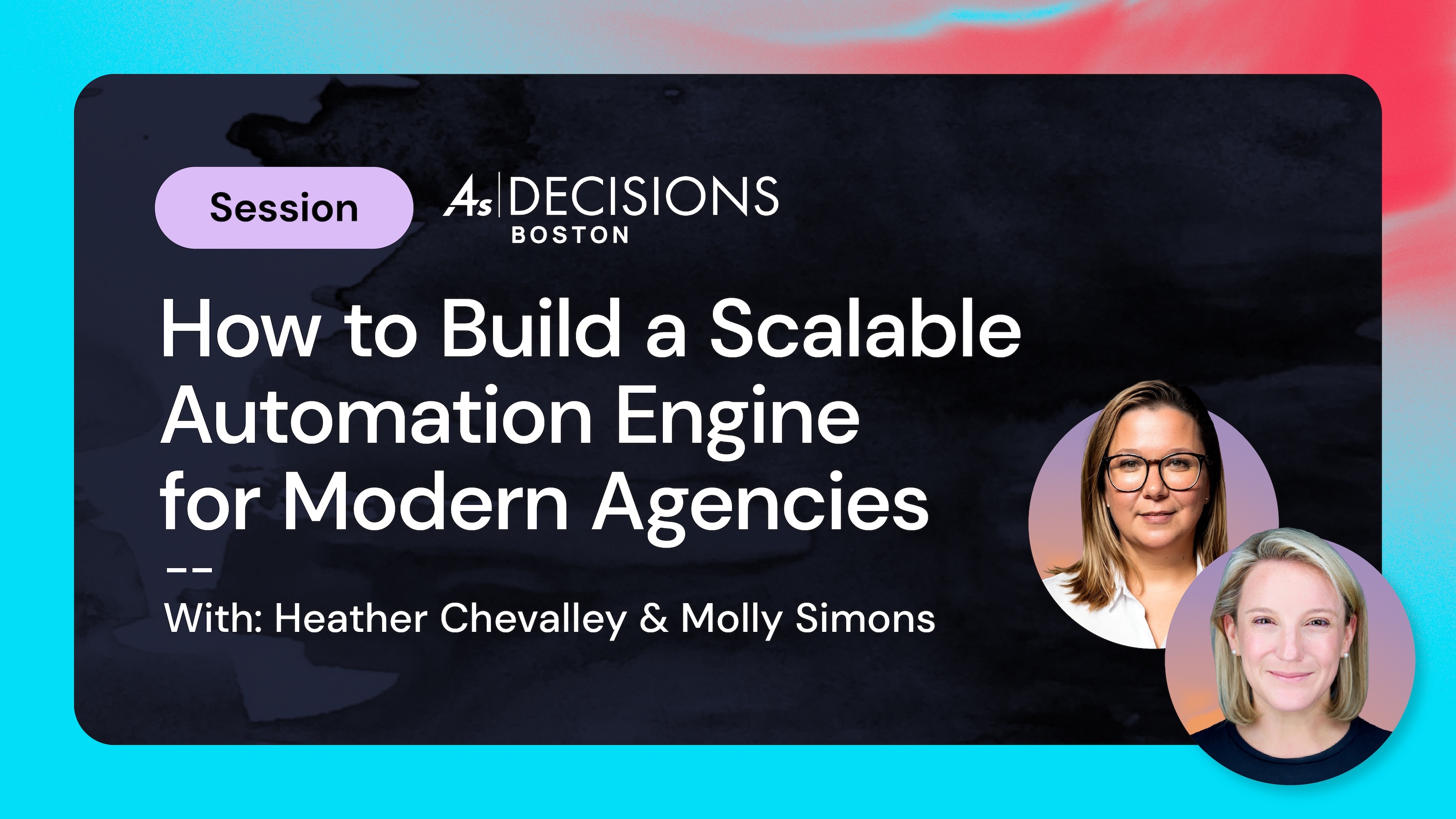
How MERGE Doubled AdOps Capacity Without Doubling Headcount: a 4As Session with Fluency

Advertising operations fragmentation is a real problem: there are more channels, more ad types, and more compliance requirements than ever before. And yet, teams still rely on the same copy-paste workflows. Unfortunately, introducing unsafe AI usage into these disconnected workflows will create more issues for advertisers instead of fixing them.
MERGE, a ~700-person independent agency running complex healthcare portfolios, wanted to build the necessary governed infrastructure that makes automation — and eventually AI — safe to run at scale.
Molly Simons, VP of Precision Activation at MERGE, and Heather Chevalley, VP of Growth at Fluency, took the stage at the 4As Decisions conference in Boston to walk through how they adopted agentic automation across their agency and what it actually looks like two and a half years in.
What you'll learn from this 4As session:
- Doubling capacity without doubling your team size: MERGE’s teams use agentic automation to handle twice as many Google Ads and Microsoft Ads accounts as they did before. The team is the same size, but they can work more efficiently and with less anxiety about overspending.
- Change management is the hardest part of agentic advertising: Getting ad strategists to give up their identity as “meticulous hands-on operators” to become strategic thinkers is harder to manage than onboarding the tech. Molly shares what worked and what didn't when she returned from maternity leave mid-rollout.
- Deterministic automation is a prerequisite for safe, scalable AI usage: You can’t run AI safely without a governed execution layer checking outputs before hitting live campaigns. MERGE worked with Fluency to build a machine-readable source of truth to make their AI agent strategy viable.
- How to enforce governance in a regulated vertical: In healthcare, campaigns have to run exactly as specified, every time. Deterministic agentic automation guarantees this. MERGE also uses Fluency’s custom notifications to surface any exceptions before they impact client campaigns.
- Why agentic automation is a growth driver: Leaning on a strong, two-layer agentic infrastructure lets Merge's sales team sell confidently at scale. They know new budgets can be activated without hiring or reworking the process.
Timestamps
0:00 | Introduction and speaker welcome
1:41 | Heather frames the problem: ad delivery hasn't changed since 2000
3:44 | What Fluency does: agentic orchestration, data activation, and more
6:03 | Molly on what drove MERGE to seek agentic automation: chasing sanity, not technology
9:05 | Change management: why the hardest part of adopting agentic solutions isn't the platform
12:34 | Data structure: building a machine-readable system of record for your AdOps
16:03 | Custom advertising notifications for proactive, not reactive, ad management
17:31 | Agentic automation outcomes: 2x account capacity, reduced overspend risk, happier teams
19:09 | Takeaways for agencies thinking about agentic automation
Top questions from this 4As session
What should agencies do first when starting with agentic automation?
Start by fixing one unwieldy campaign instead of your whole portfolio. MERGE brought agentic automation in to assist with a complex healthcare client first, built a repeatable framework, and expanded their strategy from there. Starting with search and budget management created a stable foundation for MERGE before they layered in additional channels, giving the team time to adjust without overwhelming them.
Why does deterministic automation matter for AI safety in advertising?
Deterministic automation is the foundation that makes your AI strategy viable at scale. AI agents are only as reliable as the execution engine powering them. Without a governed, deterministic infrastructure double-checking AI outputs against your codified rules before hitting live campaigns, AI may not operate within your set budget constraints, brand requirements, or compliance obligations.
How do you enforce brand and compliance requirements across thousands of campaigns?
Encode your advertising brand and compliance requirements into your deterministic execution layer rather than rely on people to manually review and catch AI-generated exceptions. For example, in healthcare, ad disapprovals and off-spec creative carry real risks for advertisers. Deterministic automation guarantees campaigns run exactly as specified. Paired with custom, real-time notifications, advertisers can surface any deviations before it impacts campaigns.
Related Content
4As: Agentic Automation in Practice - Real Use Cases for Scaling Ad Campaigns