How MERGE Operationalized Agentic Automation Across a 700-Person Agency: 4As Decisions DC 2026

MERGE, a ~700-person independent agency with eight offices, was having a hard time effectively managing complex healthcare budgets across Google, Microsoft, Meta, and programmatic.
The agency’s strategists spent half their day performing manual pacing checks instead of evolving client strategies. Growth was equally challenging: the company’s sales team couldn't confidently sell new budgets because it meant hiring more operations team members. The agency wanted to scale its growth, but without scaling the manual workload that came along with it.
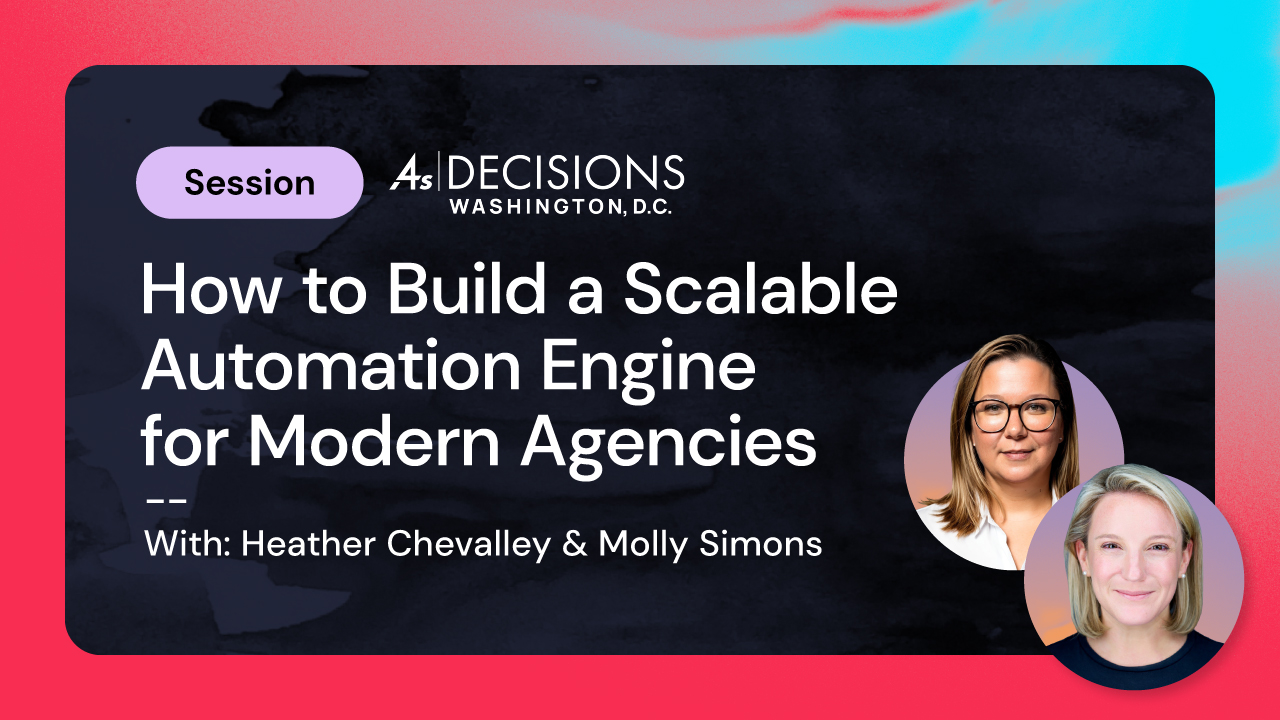
In this session from 4As Decisions DC 2026, Molly Simons (VP of Precision Activation at MERGE) and Heather Chevalley (VP of Growth at Fluency) walk through how the agency operates today after using agentic automation to power its advertising operations for two and a half years.
What you'll learn from this session:
- How MERGE doubled account capacity with the same team: MERGE’s teams now handle twice the Google and Microsoft Ads volume they did before using Fluency’s agentic automation solutions. Plus, they do it without near-constant anxiety or burnout that accompanied manual campaign management.
- Reducing risk in a highly-regulated industry vertical: In healthcare, ad disapprovals are a must-fix issue. Fluency’s automated, custom notifications surface problems for MERGE’s strategists in real time, replacing the company’s previously reactive scrambling with proactive campaign management.
- Building a single source of truth for multichannel campaign execution: Working with Fluency, MERGE moved all its media planning and activation into one machine-readable data structure. Using agentic automation ensures that a client’s name change doesn't require re-trafficking 1,800 ads.
- Why deterministic automation is vital for safe, governed AI usage: AI agents are only as reliable as the execution layer underneath them. Without a governed, deterministic infrastructure, there's no way to guarantee what AI will do on live campaigns. MERGE built the foundation first and worked with Fluency to set the right operational bounds, ensuring their AI strategy is viable.
- Ad ops as a growth driver: When execution is scalable and stable, a new $5M monthly budget can be activated without pummeling the advertising operations team. This is why MERGE’s sales team can now confidently sell new business, trusting that the work can be executed correctly and in a timely manner.
Timestamps
0:00 | Introduction and speaker welcome
1:00 | The AdOps problem: still manual, still archaic
2:00 | What Fluency does: agentic automation for advertising
4:53 | MERGE’s goals when they started: capacity, risk reduction, growth
7:00 | How they prioritized: one campaign, one problem, search first
8:24 | Change management is 75% of the challenge with agentic adoption
10:01 | Where MERGE is now and where they're going: single source of truth
12:03 | Agentic automation as an AI enabler: why data structure comes first
14:00 | Hiring for value creation, not task management
16:00 | Agentic automation as a competitive differentiator
18:28 | Q&A: how is the MERGE team responding to the changes?
Questions from this 4As session
What is the hardest part of adopting agentic advertising automation?
According to Molly Simons from MERGE, change management accounts for 75% of the challenge in adopting agentic automation, not the technology. AdOps teams have built their professional identity around manual precision. Advertising leaders must communicate clearly that agentic automation eliminates the least rewarding parts of their work (not their jobs): this is what determines whether agentic adoption succeeds or stalls.
How did MERGE approach automation without overwhelming the team?
MERGE started with a single healthcare client campaign, built a repeatable agentic framework in Fluency Blueprints, and expanded from there. Beginning with search campaign management and budget pacing gave the team a stable foundation before adding in social campaigns and programmatic channels.
What does a "system of record" mean for an advertising operations team?
A system of record in advertising operations is a machine-readable, centralized data source that stores all campaign information—budgets, copy, creative, targeting—and connects directly to publishing platforms. It replaces bespoke per-client spreadsheet setups and makes bulk changes, QA, and AI analysis possible without manual re-trafficking.
How does agentic automation help agencies become a growth driver?
Agentic automation ensures that advertising operations task execution is stable and scalable. This means a sales team can confidently sell new budgets knowing the operations team can absorb them without expanding the team or being overloaded with rework. MERGE is building toward this agentic advertising model through its partnership with Fluency.
Related Content
4As: Agentic Automation in Practice - Real Use Cases for Scaling Ad Campaigns