
General Muse functionality questions
What kind of training will be offered on the different Muse offerings you shared on the webinar?
Like many AI tools out there, Muse was built to engage with you conversationally and shouldn’t require detailed training; we hope it feels intuitive to use. That said, the best place to get more information right now is from your Client Services representative. They can provide you with an overview and, hopefully, relatively simple training.
Some of the newer features shared on the webinar are still in the early adopter phase. Our product team is still actively integrating feedback from our early access users. Help Center materials, when necessary, are launched when features are available to the general public.
How deep into account performance data does Muse go? For example, can it exceed what can be seen within Fluency?
We do not currently grant Muse direct access to the ad networks. We intentionally implemented safeguards into Muse’s processes, which are enforced through the Data Explorer software controls.
As far as what Muse can access within Fluency, Muse has access from the highest level (e.g., account/portfolio info) to the lowest leaf nodes (e.g., keyword, creative, extension, etc.).
Our goal is that Backpack has the data it needs to do its job and help your teams. That said, if there are datasets or signals you want to see that don’t currently exist within Data Explorer, please let your CS representative know so we can work on getting them into Data Explorer.
Does Muse have the native intelligence to identify industry verticals, or do I need to provide specific account lists to see industry-specific trends (e.g., “handyman services” trends) across accounts?
Yes, Muse can do this if you specify the vertical. When you create, import, or update an account in Backpack, you can set the account's vertical. Doing this ensures it's available in Data Explorer and, therefore, available to Muse.
However, if you want the AI to determine the vertical without your input, it is technically possible but it does not exist yet in Muse. We would need to build a "vertical resolving agent” (basically, a website reader followed by an AI vertical interpretation of the site) to make this possible.
Can I use Muse to make bulk edits?
While this is a great idea, there’s a lot of liability in giving Muse (or any AI) this functionality. Like a human, AI is not perfect: even if a bulk edit AI feature tests out perfectly, it is likely to make a mistake.
There is no technical barrier to making this possible, but right now, our product team is not comfortable asking AI to run unattended for this kind of task.
Can Muse’s analytical capabilities help me run marketing mix models versus direct attribution for optimizing performance?
Yes, you can use Muse to do this, but remember: like a human, it can make mistakes. (Also, as you probably know, the "perfect mix" is a highly subjective concept.)
That said, Muse can absolutely build you a recommended media mix AND give you its reasoning. However, you should think critically and determine if Muse’s reasoning matches yours.
Is Muse better at helping with specific business goals or industries over others?
Muse is trained on such a large publicly available dataset that it should behave reasonably for all industries. That said, like any AI tool, Muse’s effectiveness depends on the volume of data it can reference.
Your owned data is always the best contextual resource for Muse. This ensures that the specific campaign strategies and tactics you actively use will provide Muse with the insights it needs to do additional forecasting and predictions. Essentially, any statistically significant dataset will be beneficial.
Muse’s PowerPoint report builder
Can we use a specific PowerPoint template (like our own) with the AI-populated report builder?
Yes! This is exactly how this was built to work. There are a ton of "default variables" that you can use, but you can also use any data from Data Explorer to make the report builder fully customized to your needs.
Can the Muse PowerPoint builder build comprehensive reports using data from all of a client’s multichannel campaigns?
Yes. This feature is INCREDIBLY flexible and can report on basically anything, as long as the data lives within Fluency. Any PPT styling, any number of slides…it's basically as flexible and customizable as Blueprints.
Muse’s budget proposal builder
Is the AI view for budget proposals available within the Beta?
Not right now, but soon. This feature is one of the early access features you can reach out to your CS representative about, but it is released as a beta “early access” for each use case.
P.S. - The proposals you saw in the webinar are prompt-driven—we'll continue to improve this functionality!
Muse and Blueprints
Can Muse help troubleshoot Blueprint tags, or explain basic Blueprint concepts without sending me to a help article?
Yes, Muse can help with Blueprint tags. Muse has the full context of how tags work and can help you address common Blueprints tag problems.
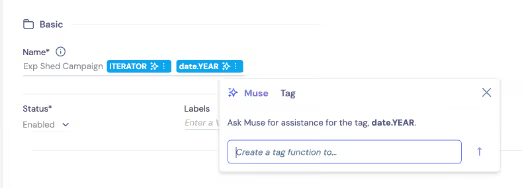
Look for the sparkle in the Blueprint Editor on your tags: this is where the Muse advisor lives:
Can we use Muse to translate a Blueprint “want” or “idea” into a functional Blueprint?
Building this capability into Muse is a pretty big and audacious undertaking. This concept actually does exist but is in testing. We're spending a lot of time looking at how accurately it works because we don’t want it to automate unsatisfactory Blueprints for you.
That said, we definitely understand the value of having Muse build Blueprints for you. It is something we are actively working on!
Last but not least…
Will there be any ad jobs left for humans in five years?
We know this question is slightly tongue-in-cheek, but the changes in how advertisers can operate are definitely eye-opening.
What we’re seeing is that AI works best when it’s well instructed. When human creativity pairs with AI’s contextual analytics and task execution capabilities, you can advance your thoughts more quickly and easily. The same goes for the companies using AI tools: the more honed-in your strategies, data, and processes are, the more effective AI will be in helping you and your teams.
AGI (Artificial General Intelligence) isn't currently here. The technology used for LLMs (aka, things that converse) seems insufficient to get us there. For now, AI’s functionality gives us a great “update” to how we (humans) interface with software and computers.
Related Posts
Agentic Programmatic Advertising for Multi-DSP Execution and Governance